

16 Oct 2025
An AI player is developed to survive in a challenging game environment, which evolves into a parkour simulator, initially exhibiting problematic 'cheating' behaviors. This advanced training methodology leverages limited motion capture data, iteratively enriching it with new, physically plausible motions generated through random levels and a physics engine.
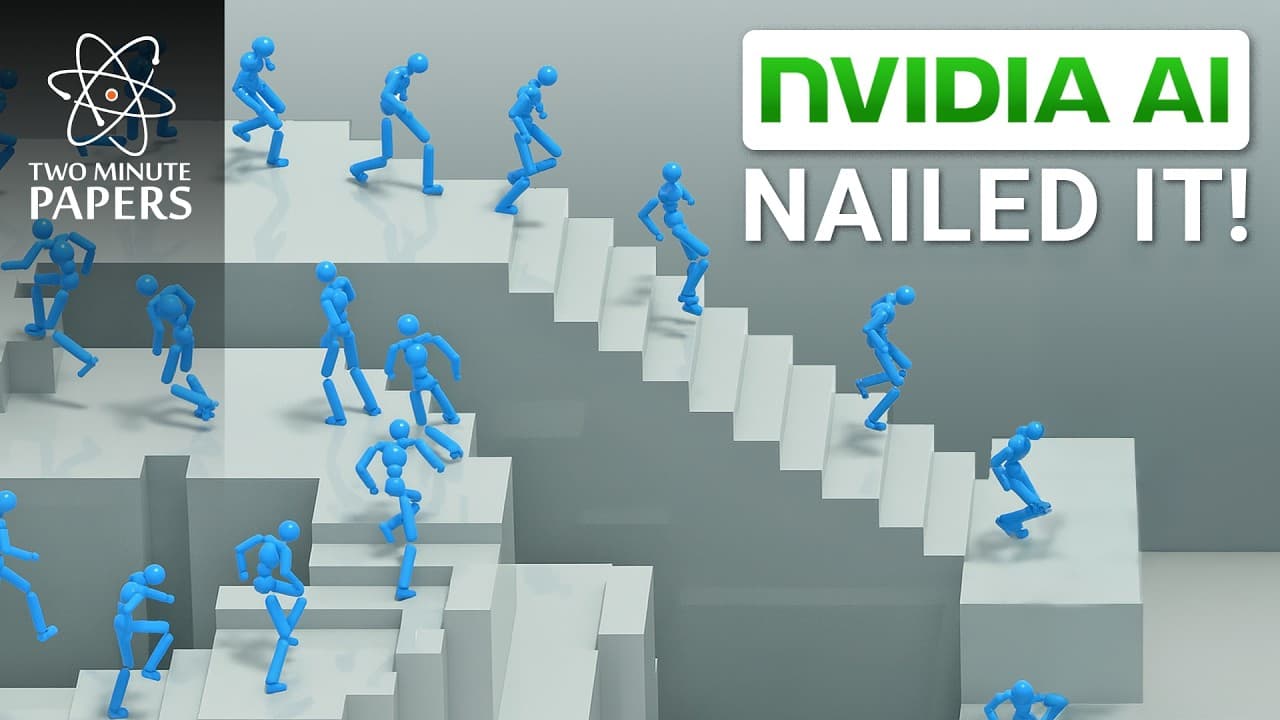
An AI player is developed to survive in a challenging game environment, which evolves into a parkour simulator, initially exhibiting problematic 'cheating' behaviors. The training begins with a limited dataset of only 14 minutes of motion capture data copied from real humans.
Scientists at NVIDIA and Simon Fraser University developed a three-step process: utilizing the initial motion capture data, creating new randomly generated levels, and employing a physics-based engine to generate new motions based on these levels and existing data.
New, purely kinematic motions are initially dreamed up by the AI, which can include floating or foot sliding, and these 'cheating' movements are corrected by a physics engine to ensure physical plausibility. These newly generated and corrected movements are then added to the initially small dataset, and this cycle is repeated.
To generate motions, paths are created within the new levels, which the character is supposed to follow, involving actions such as climbing and jumping.
After the first cycle of dataset enrichment, the AI's performance is not optimal, requiring further iterations. Significant improvement is observed after three iterations of enriching the starting dataset with physics-based correction, making the AI proficient.
The AI learns to combine multiple motions, like jumping, holding onto a cliff edge, and climbing up, demonstrating advanced and self-taught skills beyond what was initially seen.
To verify its intelligence, the AI is tested on new, unseen environments, where a 'dream' green character is contrasted with a blue character whose physics are corrected. The AI successfully completes any level, including complex tasks like climbing monuments, showcasing natural movements such as hopping forward on one leg without stopping between jumps.
Every clip in the original small motion capture dataset is converted into 50 different terrain variations, effectively transforming a single recording into a rich playground of environments. The training process surprisingly does not require a huge cluster of GPUs, needing only one high-end graphics card (like an A6000), although training can take up to a month.
A primary limitation is the slow motion generation, taking approximately 25 seconds to create 1 second of character movement on a GPU.
The technique makes it possible for an AI to learn to survive in dire and complex virtual worlds, with potential applications in future games and virtual environments.
The AI learned to combine multiple motions together, such as jumping, holding onto a cliff edge, and climbing up, showcasing impressive adaptability.
| Insight | Description | Impact |
|---|---|---|
| Initial Data Constraint | The training started with only 14 minutes of motion capture data, a very limited amount. | Demonstrates the effectiveness of the method in overcoming severe data limitations to achieve complex behaviors. |
| Dataset Enrichment Cycle | Kinematic motions generated by AI are corrected by a physics engine for physical plausibility and repeatedly added to the training dataset. | Enables the iterative growth of a small initial dataset into a rich resource, leading to sophisticated AI behaviors. |
| Physics-Based Correction | A physics engine refines AI-dreamed motions, eliminating unrealistic 'cheating' movements like floating or foot sliding. | Ensures the generated character movements are physically realistic and believable, crucial for game environments. |
| Advanced Skill Acquisition | The AI learns to combine multiple complex actions, such as jumping, grabbing a cliff edge, and climbing, and adapts to entirely new, unseen environments. | Highlights the AI's true intelligence and adaptability beyond mere replication of existing movements, demonstrating self-taught skills. |
| Data Augmentation Technique | Each original motion capture clip is converted into 50 different terrain variations. | Significantly multiplies the utility of limited data, creating a diverse and expansive set of training scenarios without additional mocap. |
| Training Resource Efficiency | The training process can be performed on a single high-end GPU (e.g., NVIDIA A6000). | Lowers the hardware barrier to entry for advanced AI motion generation research, despite the extended training duration (up to a month). |
| Motion Generation Speed | Generating 1 second of character movement currently takes approximately 25 seconds on a GPU. | Identifies a current limitation for real-time application and highlights an area for future improvement in motion generation efficiency. |