

20 Oct 2025
Mimicking human motion for digital characters presents a significant challenge, as raw motion capture data fails to specify the underlying forces and torques required for faithful reproduction. However, a new system called ADD introduces an automatic AI judge that learns what perfect performance looks like, overcoming the manual tuning limitations of prior methods like DeepMimic.
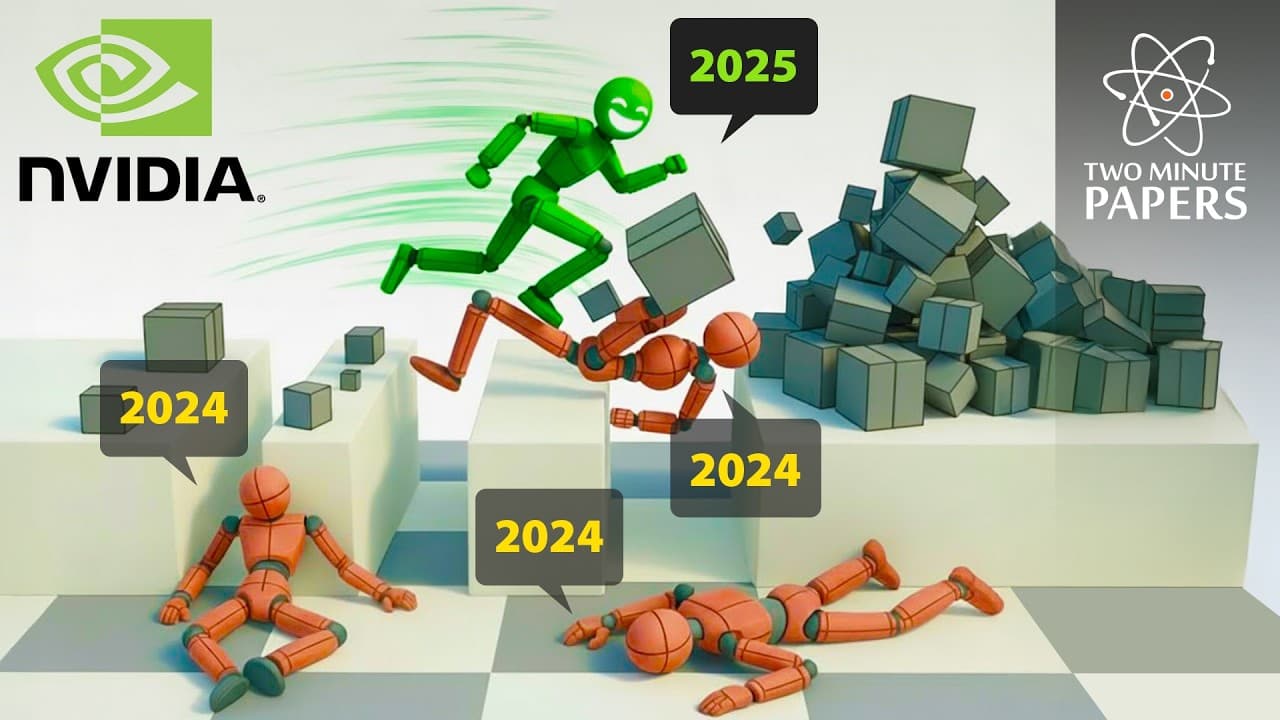
Directly copying human motion for digital characters is impossible because motion capture data only shows what movements occur, not the underlying how—the specific forces and torques needed for virtual muscles and joints to mimic them.
DeepMimic successfully matched reference motions by framing imitation as a video game, where a controller repeatedly tweaked moves to maximize a score based on joint angles and contacts, achieving perfect motion capture performance.
DeepMimic operated effectively across diverse body morphologies, demonstrated robustness against external disturbances like thrown boxes, and allowed for artistic direction to vary motion vigor.
A significant drawback of DeepMimic was the necessity for manual design and tuning of hundreds of individual score counters for elements like joint rotations, velocities, and center of mass, making it labor-intensive and difficult to adapt to new motions or body types.
The ADD system addresses DeepMimic's manual tuning problem by introducing an AI judge that automatically learns to distinguish perfect motion from imperfect motion, providing a single verdict instead of requiring hundreds of hand-coded scores.
During training, the ADD system's AI judge iteratively refines its understanding of ideal performance, focusing on areas that appear "off" and pushing the character to improve its motion closer to real human movement.
While initially showing comparable performance on some tasks, ADD significantly outperforms DeepMimic on complex parkour and climbing movements, producing fluid, believable, and physically correct motions where DeepMimic often fails.
ADD retains DeepMimic's ability to work with various body morphologies, including unconventional ones like a "walking sausage man," and can control robots, allowing them to fall and recover, and perform a wide range of complex behaviors.
An ablation study confirmed the utility of each individual component invented for ADD, demonstrating that every piece is necessary for the system's successful operation.
Despite its advancements, ADD sometimes struggles with "flashier tricks," where the AI judge can become confused and fail to execute complex maneuvers, similar to a dance judge unfamiliar with extreme movements.
AI systems are progressing beyond mere motion imitation to understand how movement occurs, suggesting that future digital creatures will achieve the grace and intent of living beings.
Highlighting and discussing novel research works, such as the ADD paper, is crucial for wider recognition and impact, likened to saving endangered species.
AI systems now don’t just imitate motion, they actually understand how we move around.
| Key Aspect | DeepMimic | ADD |
|---|---|---|
| Fundamental Challenge | Addressed by using motion capture data to define 'what' to do, but struggled with 'how' (forces/torques). | Overcomes the 'how' by learning to distinguish perfect motion automatically, reducing reliance on manual force specification. |
| Imitation Mechanism | Turned motion imitation into a video game, optimizing against hundreds of hand-designed score counters. | Introduces an AI judge that automatically learns what constitutes perfect performance, providing a single learned verdict. |
| Tuning & Adaptability | Required extensive manual tuning of score counters for each specific motion or body morphology, leading to high labor costs. | Eliminates manual tuning, making the system automatically adaptable to new motions and diverse body types, significantly improving scalability. |
| Performance on Complex Tasks | Achieved superb motion matching on many tasks but failed on highly dynamic and complex movements like parkour. | Demonstrated superior performance on challenging tasks like parkour and climbing, producing fluid, believable, and physically correct motions. |
| Versatility & Robustness | Worked on different body morphologies and was robust to external forces. | Retains DeepMimic's versatility, operating on diverse morphologies and controlling robots, while enabling a wider array of complex behaviors and robust recovery from falls. |
| Future Potential | Represented a significant step towards realistic motion imitation. | Propels AI beyond mere imitation towards understanding human movement, promising digital creatures with grace and intent. |