

30 Oct 2025
A groundbreaking research work by Weta FX introduces a new computer simulation technique that unifies the rendering of bubbles across all scales. This innovation effectively solves the long-standing challenge in visual effects of simultaneously depicting both large and tiny bubbles, which previously required clashing, separate systems.
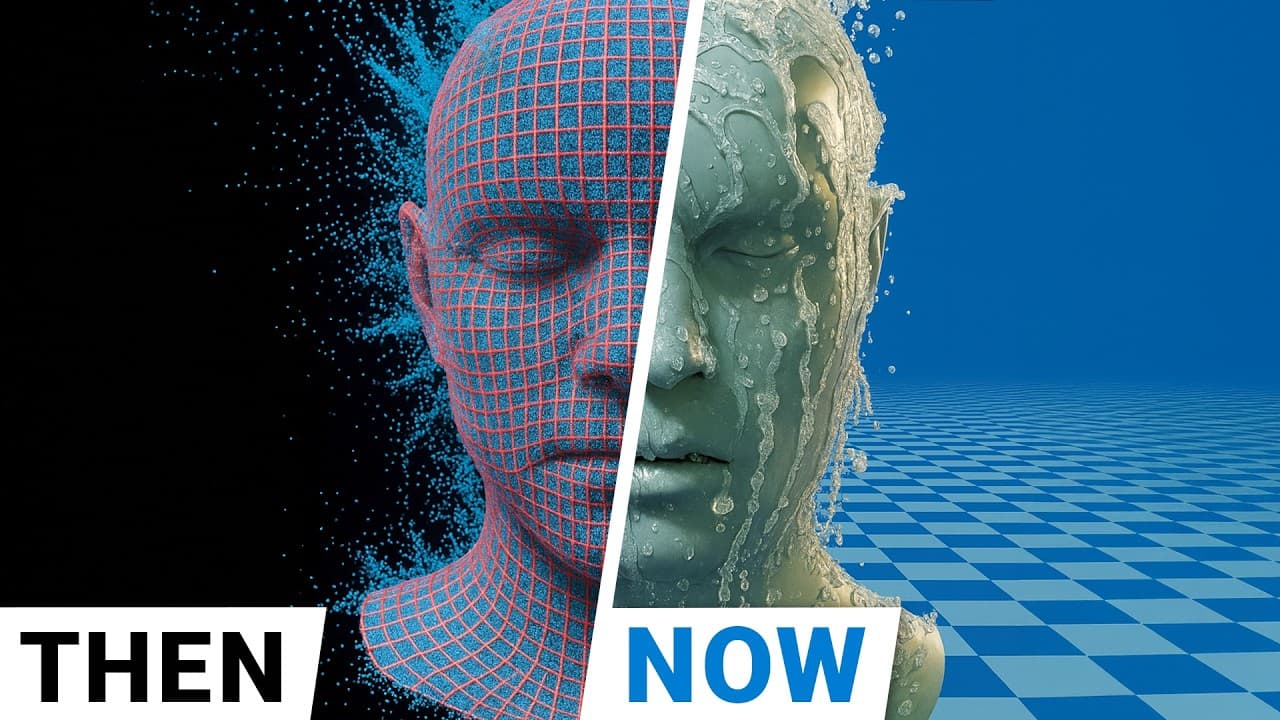
A groundbreaking research work developed by Weta FX introduces a new computer simulation technique for rendering bubbles, praised as one of the best of the year for its exceptional realism. This innovation addresses the long-standing challenge in visual effects of simultaneously depicting both large and tiny bubbles, which previously required separate, clashing systems.
Earlier simulation methods treated fluid elements as particles, enabling seamless transitions between splashes and foam. These techniques primarily identified bubble and foam formation in regions where air was trapped within the fluid, such as wave crests characterized by high and locally convex fluid geometry curvature, and areas where fluid particles rapidly converged, proving simple yet effective for surface phenomena.
Despite their efficiency for surface effects, previous bubble simulation methods completely failed to accurately model underwater bubbles, particularly their complex behaviors like merging or breaking apart, thus lacking the capability to realistically portray deep-water bubble dynamics.
The new method proficiently simulates a diverse range of bubble sizes, from minute to large, allowing them to coalesce and separate underwater with real-world fidelity. It achieves this efficiency by employing a sparse grid of 3D tiles that adaptively focuses computational power only on active areas, and it can also seamlessly integrate and simulate elements with vastly different densities, such as bubbles, sand, and water, within a unified system.
A detailed parameter study demonstrates that bubble size critically influences their ascent: the smallest bubbles (3-5mm) rise smoothly in straight paths, medium-sized ones begin to wobble and change shape, while larger bubbles (above 18mm) exhibit chaotic movements, twisting and fracturing into smaller components, accurately replicating natural physical phenomena.
The simulation's sophisticated realism is powered by the "particles-to-grid velocity transfer with surface tension correction step," a core mathematical framework that integrates the motion of individual bubble particles into a grid while precisely accounting for the influential forces of pressure and surface tension, ensuring a harmonized and physically accurate fluid flow.
A current limitation of the advanced bubble simulation is that its level of detail and realism diminishes when bubbles become exceedingly small or their quantity is too few.
A study on surface tension highlights its crucial role in bubble stability: an absence of surface tension causes bubbles to easily break apart and scatter, whereas increasing surface tension results in bubbles holding together more tightly and maintaining greater stability.
The simulation's performance varies with complexity; small, diffuse bubble columns can run almost interactively, while large, intricate scenes, such as an overturning barrel, require approximately 22 minutes per frame when processed on a single machine.
This groundbreaking bubble simulation research was recognized with the best paper award at the Eurographics conference, underscoring its significant contribution to computer graphics, particularly in rendering realistic physics for visual effects.
This research work finally fixes that - one simulation that handles everything from a single bubble to huge blobs.
| Feature | Description | Benefit |
|---|---|---|
| Unified Bubble Simulation | The system handles all bubble sizes, from tiny misty ones to huge blobs, within a single simulation framework. | Eliminates the need for multiple, conflicting simulation systems, preventing visual glitches and simplifying artist workflows. |
| Realistic Underwater Dynamics | Accurately simulates complex bubble behaviors such as coalescing, separating, and chaotic movement deep underwater. | Achieves unprecedented realism for scenes involving underwater bubble interactions, surpassing limitations of previous methods. |
| Adaptive Computational Efficiency | Utilizes a sparse grid of 3D tiles to dynamically focus computational resources only on active regions of the simulation. | Enables efficient rendering of scenes with a stupendous number of particles by optimizing where computation is spent. |
| Multi-Substance Interaction | Capable of simulating the interaction of elements with vastly different densities, such as bubbles, sand, and water, within the same scene. | Broadens the scope of realistic fluid simulations to include diverse material interactions seamlessly. |
| Precise Surface Tension Modeling | Accurately depicts how varying levels of surface tension influence bubble stability, causing them to hold together or break apart. | Offers a critical physical parameter for fine-tuning the visual fidelity and stability of simulated bubbles. |
| Size-Dependent Bubble Behavior | Simulates distinct rising patterns based on bubble size: smooth for small, wobbling for medium, and chaotic for large (>18mm) bubbles. | Provides physically accurate and visually compelling variations in bubble movement that enhance realism. |