
16 Oct 2025
Google DeepMind's latest generative video model, Veo 3, demonstrates unprecedented fidelity and a wide range of emergent capabilities, far surpassing expectations for current AI video generators. This AI exhibits complex understandings of physics, material properties, and visual transformations, learning these concepts autonomously without explicit programming.
Veo 3 is Google DeepMind’s latest generative video model, which converts text prompts into video outputs with remarkable fidelity and realism. While powerful, it is also noted for being expensive.
The AI can generate videos from an initial image combined with a text prompt, such as creating a video of a burrito being rolled from a starting image, demonstrating unbelievable capabilities.
Veo 3 understands complex real-world concepts like color mixing, accurately predicting the outcome when two kinds of paint are combined, a feat challenging for traditional simulations.
The model demonstrates the ability to transform one object into another, for instance, a teacup into a mouse, while meticulously retaining the original object’s motifs and overall style. Even specular highlights on objects change realistically during transformations.
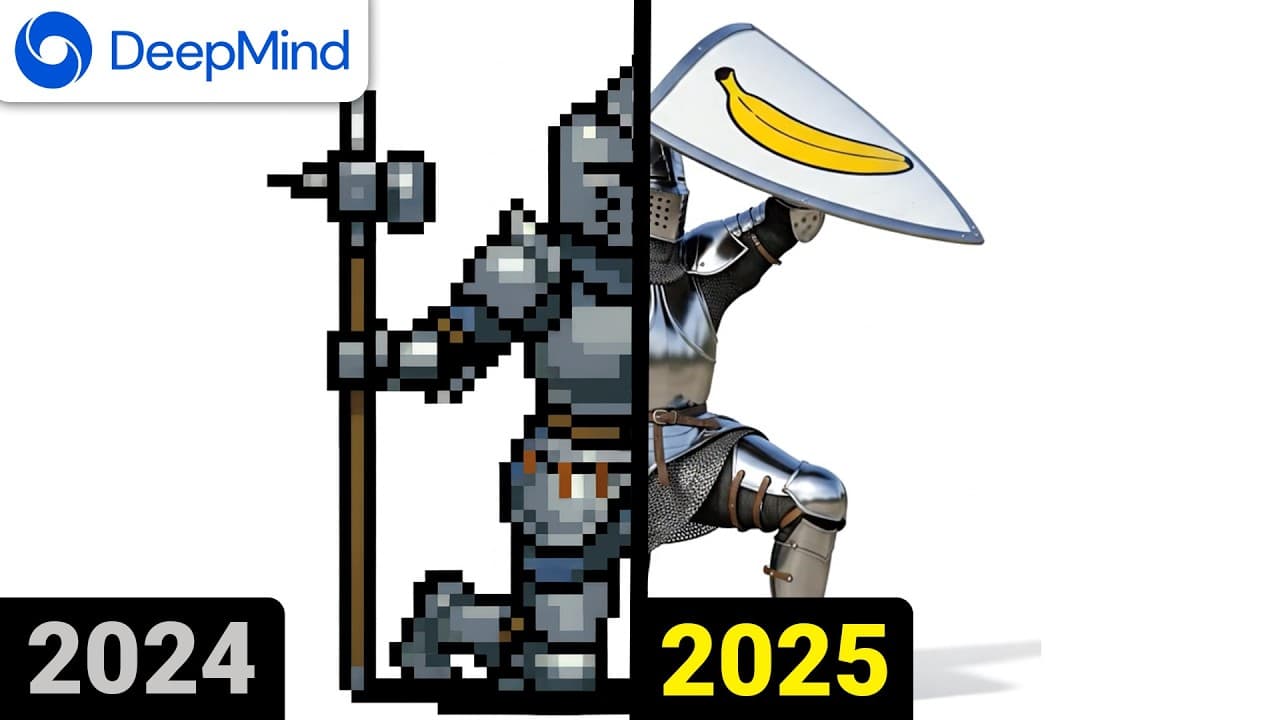
Veo 3 can animate 3D models based on text commands, such as making a character drop onto one knee and raise a shield. It maintains completely consistent reflections on surfaces like armor throughout the entire video.
The AI handles complex physical phenomena including refractions and soft body simulations. It also understands material properties, accurately depicting what would happen if paper were burned.
Veo 3 effortlessly performs various image manipulation tasks, including inpainting (filling missing parts of an image), outpainting (imagining the world beyond an image's borders and zooming out), edge detection, segmentation, super resolution, denoising, and low-light image enhancement.
Crucially, Veo 3 was not explicitly programmed for any of its sophisticated capabilities. Instead, it learned these complex concepts autonomously by analyzing vast amounts of video data on the internet, behaving like a child learning.
Despite its advancements, Veo 3 is not without flaws; it can get confused, sometimes failing to correctly solve puzzles or perform well on IQ tests. The model still makes numerous mistakes, which are detailed in the accompanying paper.
The authors describe Veo 3's reasoning process as a 'chain of frames,' where the video model demonstrates its step-by-step thinking through moving pictures, with each new frame representing the next logical step in its reasoning.
All of these things it can do are emergent capability, meaning it has looked at a large amount of videos on the internet and learned these concepts by itself.
| Capability | Description | Detail |
|---|---|---|
| Realistic Video Generation | Generates high-fidelity, photorealistic video content from text prompts. | Can create a video of a burrito being rolled from an initial image. |
| Complex Concept Understanding | Understands advanced concepts like color mixing and physical interactions. | Accurately shows outcomes of mixing paints or burning paper. |
| Object Transfiguration | Transforms objects while preserving style, motifs, and realistic lighting. | A teacup transforms into a mouse, retaining patterns and realistic specular highlights. |
| Consistent Physics & Reflections | Simulates consistent physical properties, including realistic reflections and refractions. | Armor reflections remain consistent throughout a character's animation, and refractions are accurate. |
| Advanced Image Processing | Performs complex image manipulation tasks seamlessly. | Includes inpainting, outpainting (zooming out to imagine surroundings), edge detection, and super resolution. |
| Emergent Learning | Acquires capabilities autonomously by learning from extensive video data. | The AI was not explicitly programmed for these tasks but learned them by itself. |
| Step-by-Step Reasoning ('Chain of Frames') | Processes and displays its reasoning in sequential video frames. | Each new frame represents the next step in the AI's logical progression. |
| Identified Limitations | Despite its power, the model still exhibits areas of confusion and makes mistakes. | Can incorrectly solve water puzzles and fails IQ tests, as detailed in the paper. |