

16 Oct 2025
This paper introduces Particle Merging-and-Splitting, a novel technique that resolves persistent collision handling issues across various physics simulations. It effectively addresses intersection bugs in solid-solid and solid-fluid interactions and significantly improves fracture simulations by treating collisions as processes rather than instantaneous events.
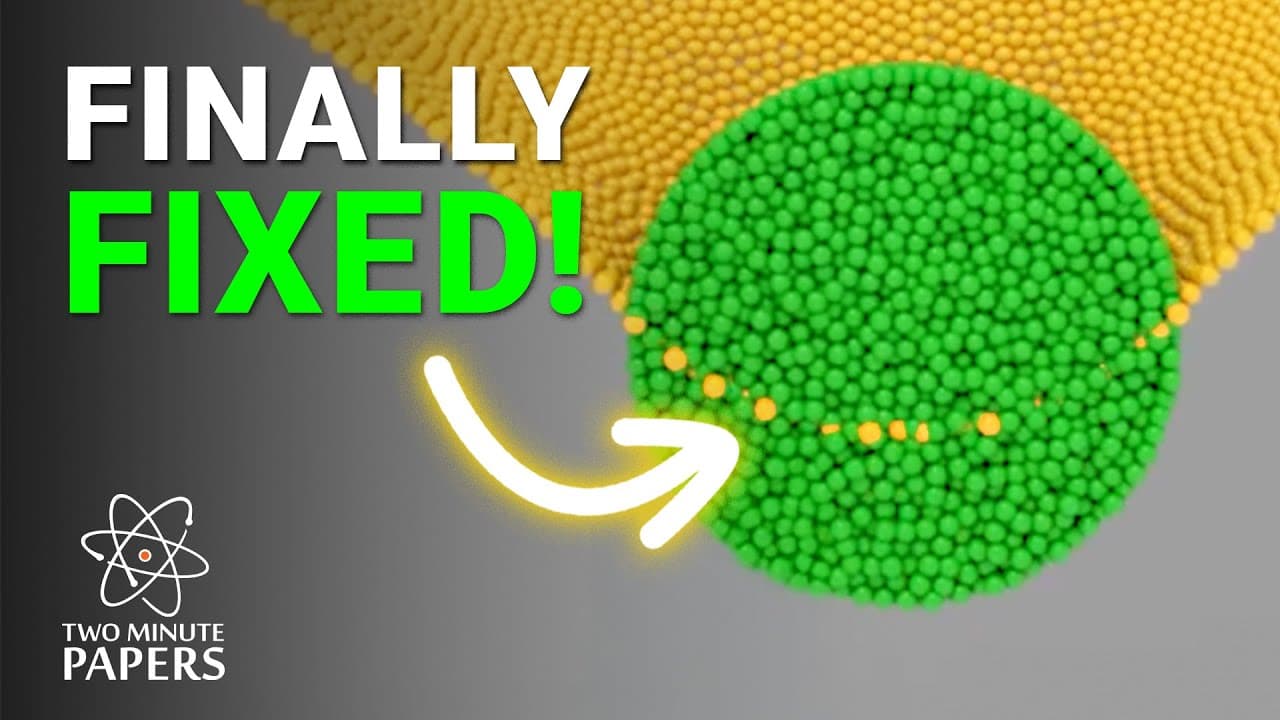
Particle Merging-and-Splitting is a largely overlooked research work capable of creating realistic physics simulations involving smashing, crumbling, and various interactions, effectively addressing long-standing issues in the field.
The intersection bug consistently plagues numerous video games and computer graphics systems, as previous collision handling systems universally exhibit this flaw, lacking a perfect resolution across all scenarios.
Common solid-solid collision handling techniques, based on force and impulse formulations, fail to effectively resolve complex collisions, leading to issues in solid-fluid interactions and highly sensitive fracture simulations where single fast particles can cause instant object crumbling.
Collisions are treated as a process taking a small amount of time where particles merge into a 'meta-particle' for one time step, storing lost kinetic energy like a compressed virtual spring. After integration, particles split, returning the stored energy, which prevents explosions and intersections.
This temporary particle 'handshake' allows completely different simulators, including solids, fluids, and fractures, to exchange information robustly, providing effective solutions for low and high-velocity solid-solid collisions, solid-fluid collisions, and complex fracturing scenarios.
The splitting and merging process typically completes in milliseconds, demonstrating lightning-fast performance, though a fully robust implementation might double the overall simulation time.
The brilliant insight of the researchers is to treat a collision not as an instantaneous event, but as a process that takes a small amount of time.
| Aspect | Description |
|---|---|
| Problem Solved: Intersection Bug | Particle Merging-and-Splitting eliminates persistent intersection bugs that plague solid-solid, solid-fluid, and fracture simulations in computer graphics, which were previously unresolvable. |
| Core Mechanism | Collisions are modeled as a time-extended process rather than an instantaneous event, where particles temporarily merge, store kinetic energy, and then split, preventing explosive instabilities. |
| Robustness Across Domains | The technique robustly handles diverse physical interactions, including solid-solid, solid-fluid collisions, and highly sensitive fracture simulations, where prior methods consistently failed. |
| Inter-Simulator Compatibility | The temporary particle 'handshake' mechanism facilitates robust information exchange between different simulation types, such as solids, fluids, and fractures. |
| Performance Characteristics | The merging and splitting operations are remarkably fast, typically completing within milliseconds, although a fully robust implementation may lead to a doubling of overall simulation time. |
| Contrast to Prior Methods | Unlike common force and impulse-based collision handling techniques, this approach successfully resolves complex collisions that previously resulted in unphysical behavior or catastrophic simulation failures. |