
29 Sept 2025
Tehm's Episode 14 of Silicon delves into the past week's hardware news, notably dissecting Apple's recent event, which was the shortest in years despite introducing multiple products. The program offers comprehensive analysis of new iPhones, advanced chips, laptops, and a handheld console, alongside critical examination of the Iranian tech market's unique challenges and fraudulent import practices.
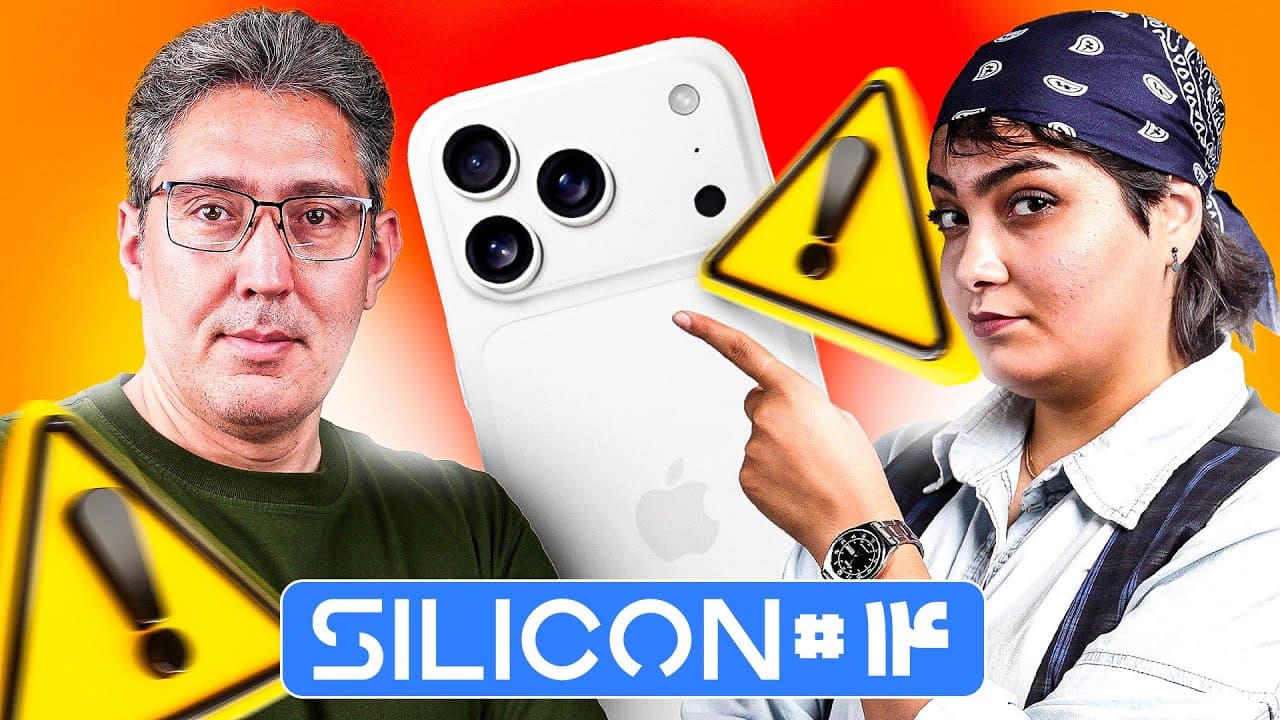
Tehm's Episode 14 of Silicon covers weekly hardware news, with a focus on the past week's events.
The program hosts were absent last week due to being busy with a significant Apple event.
The recent Apple event was the shortest to introduce an iPhone in at least six years and was considered one of the best in terms of product introductions.
The one-hour event introduced between four and eight products, allocating less than ten minutes to each product.
The event noticeably lacked CGI and Fideriti's usual engaging presentation, instead featuring live performances, aligning with a visual trend adopted by many advertising companies.
The iPhone 17 normal model became the most complete to date, incorporating a 120 Hz display and a base memory of 256 GB.
Its camera was upgraded to 48 megapixels, and the selfie camera also saw improvements.
Maintaining its $800 price, the iPhone 17 is considered a very good phone that competes effectively with devices like the regular S25 or Pixel 10.
Following the iPhone 16's success as the most popular phone, the iPhone 17 is expected to become the world's most popular phone within the Apple ecosystem.
The iPhone Air is promoted as the thinnest and most resistant Apple phone, though its thinness measurement, excluding the camera bump, is questioned.
The Pro Max models feature design changes, although many people commented on not seeing any significant alterations.
The Pro font used for the iPhone felt uncharacteristic for Apple, resembling fonts typically seen in gaming or Chinese brands.
The orange color option for the iPhone Pro Max was debated, with some considering it unprofessional for a flagship device, while others suggested it was a strategic choice to signify happiness and a departure from minimalist design.
Apple was accused of officially misleading customers regarding its '8x optical' zoom for the Pro Max and '2x optical' zoom for the iPhone 17, as these terms refer to lossless digital zoom rather than true optical zoom.
iPhone 17 battery replacement costs $100, while other models incur a $120 fee.
Display replacement for new iPhones typically ranges from $300 to $400, with the Pro Max display costing $470 if the entire panel is damaged.
Camera repair for Pro and Pro Max models costs about $250, and $170 for the 17 and Air models.
Repairing other damages, such as a burnt or non-functional phone, costs $600 for the iPhone 17 and $800 for the iPhone 17 Pro Max.
AppleCare Plus can reduce these repair costs to a minimal amount (e.g., $20-30), potentially encouraging its adoption.
The A19 Pro benchmark results show no surprising progress in CPU performance, but a remarkable 7 to 10 times improvement in GPU performance over the previous generation.
The GPU of the A19 Pro has become as powerful as a laptop's GPU, raising questions about its practical application in a phone.
For the first time, all new iPhones, including the standard models, incorporate a vapor chamber for cooling.
Previous iPhone models suffered from significant heating issues, and the effectiveness of the new cooling system on the powerful A19 chip needs to be tested under real-world conditions.
The new-generation Asus ProArt 16 laptop features 59 graphics, a 16-inch touch screen with 3840x2400 resolution, 1600 nits brightness, and a 120 Hz refresh rate, supporting Ryzen A series chips.
It comes with up to 64 GB LPDDR4 RAM, 4 TB of internal memory, and the 59 graphics card has a power consumption of 120 watts.
Priced at $4000 globally, this laptop is designed for professionals who can generate income with its capabilities, though its price in the Iranian market is significantly higher, reaching around 500 million Toman.
Lenovo introduced the Legion Go at IFA, touting it as the most powerful and expensive handheld console in history.
It is a Windows console powered by a powerful AMD Ryzen Extreme processor, supports up to 32 GB of RAM, and features an 8-inch, 30-144 Hz screen.
Equipped with a 74 watt-hour battery, it offers a better screen than its predecessors and directly competes with devices like the ROG Ally.
The Legion Go is priced between $1000 and $1500 and is expected to be released in Fall 2025.
Lenovo's Verti Flex laptop features a screen that can rotate vertically, appealing to programmers, though the practicality and market fit of such a design were questioned based on past similar innovations like the LG Wing phone.
The updated Legion Pro series now features RTX 580 graphics and the latest AMD Ryzen 900HX series processors.
These laptops include a 16-inch OLED display with a 240 Hz refresh rate and a very low 0.8 ms response time.
Specifications for the flagship series include up to 3 TB SSD storage and 32 GB of RAM.
The Legion Pro series is priced at $2400 and is expected to be available from November 2025.
Lenovo introduced a gaming desktop version of its popular Alu Q series, named Hello Q Tower 26 IDR T1, featuring Ryzen 8000 series processors and P series graphics cards, starting at $1000.
Acer updated its flagship Helios 18-inch gaming laptop with new hardware, including a Corsair 285HX processor with V-Pro technology.
This laptop supports up to 192 GB of ECC memory and includes a 59 graphics card, positioning it more as a workstation than solely a gaming laptop.
The device features an 18-inch mini-LED display and is priced between 4000 and 5000 Euros.
The Acer Nitro series offers mid-range gaming laptops with good screens and higher refresh rates, featuring processors like the 270H and graphics cards such as the 50 or 70 series, though finding them under 80 million Toman in Iran is now difficult.
Acer introduced the Swift Air 16 as a competitor to the MacBook Air, notable for its 16-inch screen while weighing under a kilogram.
Utilizing Ryzen AI 300 series chips, its processing power and energy optimization appear weaker compared to Apple's chips.
It features an IPS-based Full HD display and a 50 watt-hour battery, providing only 13 hours of video playback, significantly less than MacBook Pro models.
The Swift Air 16 is expected to enter the European market in November with a base price of 1000 Euros.
The new Intel Core Ultra 35, replacing the Core iT series, demonstrates at least 30 times better multicore performance than the 14th generation and improved graphics capabilities.
Intel's Core 11 is a rebranded Core iT 10th generation processor, essentially the same package with a new name.
Xiaomi's new S-Pro TV series for 2020 features mini-LED screens with an impressive 5200 nits brightness and a 165 Hz refresh rate, which can be overclocked to 330 Hz for gaming.
These TVs cover 95% of the DCI-P3 color gamut, display 10 billion colors, and a 65-inch model costs $909 globally, but would face severe price inflation and import challenges in Iran.
The trend of adding displays to RAM modules, exemplified by Xfinity showing frequencies, is criticized as useless due to RAM's typical lack of visibility inside a PC case.
A system buying guide for the Iranian market noted that a 50 million Toman budget is now unrealistic for a true gaming PC.
A 20 million Toman system would typically include an Intel i3 10th gen or 105 CPU, 8 GB RAM, and integrated graphics, suitable for basic office and administrative tasks.
A 30 million Toman system upgrades to a new Intel i3 14th gen CPU, 16 GB RAM, and improved onboard graphics, capable of running some normal games like Counter-Strike.
A 40 million Toman system features an Intel i5 14400 CPU and 16 GB RAM, still relying on onboard graphics as a discrete GPU remains unattainable at this price point.
A balanced 50 million Toman system includes an Intel i3 130F CPU, 16 GB DDR4/DDR5 RAM, and an RTX 3050 graphics card (approximately 20 million Toman of the budget), making it suitable for Full HD gaming.
Thirteen Iranian importing companies have been fraudulently declaring expensive phones, like iPhones, as cheaper models (e.g., Xiaomi, Samsung) to evade higher import tariffs.
This fraud leads to legitimate buyers' iPhones having their antennas deactivated because the phone's true identity conflicts with its under-declared registration in the system.
Officials have promised to reactivate the antennas of affected phones, but no public action against the fraudulent importing companies has been announced.
Iranian mobile operators' sudden claim of seven years of eSIM readiness, coinciding with new iPhone requirements, contradicts previous excuses of sanctions and suggests strategic timing.
Chinese versions of iPhones offer dual physical SIM cards, suggesting that single eSIM models might have been prioritized for import into Iran to maximize profitability rather than due to technical limitations.
The A19 Pro benchmark results indicate no significant CPU progress but a surprising seven to ten times better GPU performance than its predecessor, making the chip as powerful as a laptop's GPU.
| Topic | Key_Insight |
|---|---|
| Apple Event Overview | The shortest iPhone introduction in six years, presenting 4-8 products within a single hour, often with less than 10 minutes per product. |
| iPhone 17 Standard Model Upgrades | Now features a 120Hz display, 256GB base storage, and a 48MP camera, maintaining an $800 price point for strong market competition. |
| iPhone Pro Max Design & Color Debate | Introduced with design changes and a controversial orange color, seen as unprofessional by some but possibly intended to convey happiness and a break from minimalist aesthetics. |
| Apple's Misleading Zoom Claims | Apple's advertised '8x optical' zoom for Pro Max and '2x optical' for iPhone 17 are technically lossless digital zooms, not true optical. |
| iPhone Repair Costs & AppleCare | High repair costs ($100-$120 for battery, $300-$470 for display, $600-$800 for other damage) may incentivize AppleCare Plus, which significantly reduces expenses. |
| Apple A19/A19 Pro Chip Performance | GPU performance sees a 7-10x improvement over previous generations, reaching laptop-level power, with all new iPhones now including vapor chamber cooling. |
| Asus ProArt 16 Laptop | A workstation-class laptop featuring a 16-inch 3840x2400 1600-nit 120Hz touch mini-LED screen, Ryzen A series processor, 64GB RAM, and 4TB storage, priced at $4000. |
| Lenovo Legion Go Handheld Console | A powerful Windows console with AMD Ryzen Extreme, an 8-inch 144Hz screen, and a 74Wh battery, priced between $1000-$1500 and competing with ROG Ally, releasing Fall 2025. |
| Xiaomi S-Pro TV Series (2020) | Features a mini-LED display with 5200 nits brightness, 165Hz (330Hz overclockable), and 95% DCI-P3 color coverage, with a 65-inch model costing $909 globally. |
| Iranian Phone Import Fraud | Iranian companies under-declare luxury phones (e.g., iPhones) as cheaper models to evade tariffs, leading to antenna deactivation for legitimate buyers, with officials promising restoration. |
| eSIM Readiness in Iran Controversy | Mobile operators' sudden claims of long-term eSIM support, coinciding with iPhone demand, contradicted past excuses of sanctions and suggested profit-driven import decisions. |