
16 Oct 2025
The world experienced is not an objective reality, as the brain actively constructs perception, edits memories, and operates in different time spheres to tell a story about the world. This active construction means the conscious self only experiences a selectively edited version of past events, making the 'present moment' an invented future.
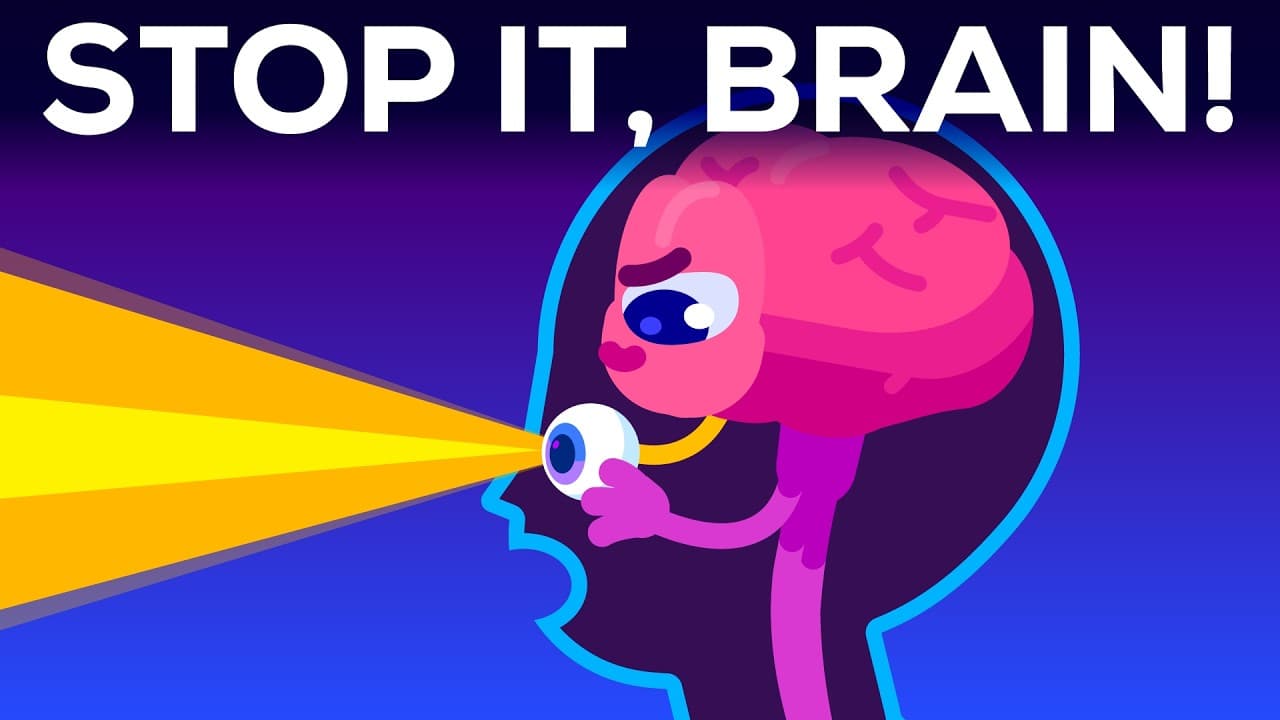
The brain actively constructs individual reality by editing memories, operating in different time spheres, and telling a story about the world that feels real. This intricate process determines what is experienced, challenging the notion of living in the exact present moment and raising questions about personal control.
Vision, a primary source of information, provides only a thumbnail-sized area of high-resolution focus, with the rest remaining out of focus. The brain employs saccades, which are 3 to 4 sudden, jerky movements per second lasting 50 milliseconds, to scan the environment and stitch together sharp images. During these saccades, the brain temporarily shuts down vision, resulting in approximately two hours of daily blindness, which it fills with its best guesses of what transpired.
Different sensory inputs, such as light hitting the eyes, sound reaching the ears, and heat being picked up by fingers, arrive and are processed by the brain at varying times. Despite this, the brain synthesizes these disparate inputs into one smooth, simultaneous, and connected moment, creating a perceived 'now' that is, in fact, a selectively edited version of the past, consciously experienced 0.3 to 0.5 seconds after events actually happen.
To enable rapid reactions, such as in professional table tennis, the brain does not display past events but instead calculates and predicts the future position of objects. It creates a fictional version of future events, like a ball's trajectory, which is what is consciously seen. The brain also pre-emptively prepares multiple motor responses based on these predictions, triggering the most likely one even before conscious decision-making occurs, effectively making conscious experience an 'invented future.'
During activities like walking, the brain operates simultaneously in three distinct time spheres: processing past sensory feedback, calculating the body's current state, and predicting future actions. It sends orders for the next step and calculates the muscle patterns for subsequent movements before sensory signals from the current footfall even reach the brain.
The body lacks a central control room; instead, different parts, such as the spinal cord and various brain regions, process events at diverse speeds and make independent decisions. In emergency situations, like slipping on a banana peel, the brain stem and spinal cord immediately trigger pre-programmed recovery patterns within 200 milliseconds, activating muscles to prevent a fall, with conscious awareness of the event arriving approximately 100 milliseconds later, after recovery has already commenced.
Internal states, including hunger, energy levels, and emotions, are primarily the brain's predictions of future needs or readiness rather than mere objective reactions. These predictions can become self-fulfilling prophecies, as the brain prepares the body by, for example, releasing hormones that induce hunger or anxiety, thereby confirming its initial forecast.
The conscious self is not responsible for most moment-to-moment decisions, which are managed by the brain and other organ systems. Its primary strengths lie in long-term planning and abstract thinking. It functions as a storyteller, shaping the narrative of one's life and possessing the unique ability to edit and write new predictions into the brain's system, ultimately holding the power to define one's story in the world.
Your conscious experience is nothing more than an invented future, a prediction based on the information your brain received a fraction of a second ago.
| Concept | Summary |
|---|---|
| Brain's Reality Construction | The brain actively constructs subjective reality, editing memories and operating across different time scales to create a coherent, perceived present. |
| Visual Perception Limitations | Only a tiny visual field is high-resolution; the brain stitches together images from rapid eye movements (saccades) and fills in blind spots, resulting in temporary daily blindness. |
| Non-Simultaneous Time Perception | Diverse sensory inputs arrive at the brain at different times but are seamlessly blended into a single 'now,' which is actually a delayed and edited version of the past. |
| Predictive Motor Control | The brain constantly predicts future states of objects and the body, pre-calculating and initiating motor actions (e.g., catching a ball, walking) before conscious awareness or decision-making. |
| Decentralized Decision-Making | Control is not centralized; parts of the nervous system (e.g., spinal cord, brain stem) make rapid, independent decisions for immediate reactions, often preceding conscious input. |
| Predictive Internal States | Hunger, fatigue, and emotions are often the brain's predictions of future needs or social scenarios, leading to physiological changes that can become self-fulfilling prophecies. |
| Conscious Self's Power | While not managing daily minutiae, the conscious self excels at long-term planning, abstract thought, and shaping the overarching narrative of identity, with the ability to influence and redefine brain predictions. |