
16 Oct 2025
The exciting idea of quantum immortality suggests an individual might be unkillable if one of physics' most profound theories is true, proposing a reality where all physically possible outcomes coexist. This concept arises from the fundamental randomness observed in particle behavior, which quantum mechanics describes through probability waves rather than definitive states.
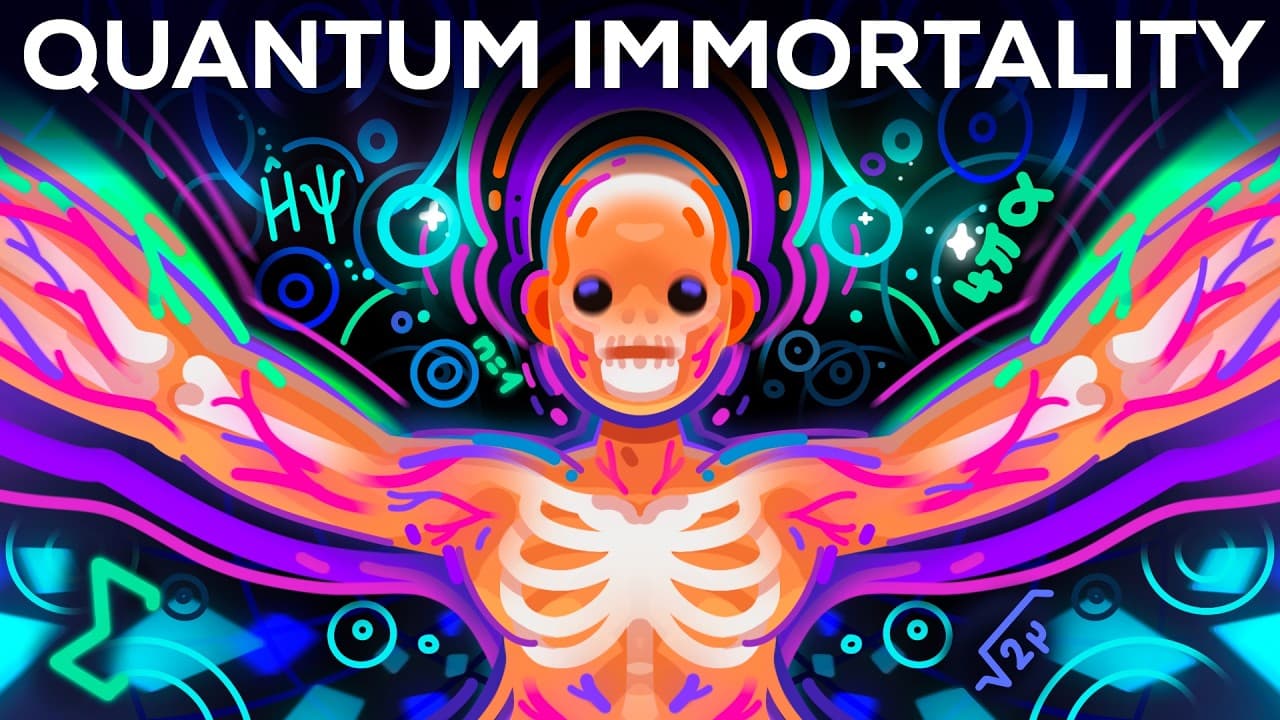
Quantum immortality suggests an individual could be unkillable, impossible to delete out of existence, if this specific idea about physics is true. This concept is real science happening around one of the most successful theories of physics.
Everyday objects behave predictably, but fundamental particles like electrons exhibit randomness; kicking an electron the same way ten times results in it appearing in different places. On the most fundamental level of reality, randomness is the rule governing particle behavior.
Quantum mechanics solves the problem of fundamental randomness by describing a particle not as a tiny marble but as a shapeshifter, a diffuse thing called a wave of probability. This immaterial essence has values between 0% and 100%, indicating the likelihood of an electron appearing in different locations.
Quantum mechanics defines how an electron behaves on average, for example, showing up 80% of the time in one room and 20% in another when shot from an electron gun. This story of probability waves works exceptionally well in reality, having been tested in countless experiments, explaining phenomena from microchip information transfer to stellar fusion.
Despite its practical success, quantum mechanics lacks a clear mental picture for what it describes, unlike other scientific theories, not telling anything about the electron itself. This has led scientists to debate its true meaning for a century.
The 'linguists' school of thought claims quantum mechanics is not a story about reality but a grammar for the universe's theoretical language, used solely for predicting experiments. This view asserts that questions about an electron's appearance or nature are beside the point, as physics focuses on experiments and calculations using probability waves.
The 'literary critics' or 'many-worldians' are convinced that quantum mechanics describes reality, interpreting it as a story where the universe is an infinitely complex quantum state. In this view, all physically possible outcomes coexist simultaneously.
If an electron's probability wave is split, like 80% to 20% between two locations, the many-worlds interpretation means the electron splits accordingly. An observer of the electron also splits into multiple versions, each experiencing one of these outcomes, existing independently without interaction.
Many-worlds implies that all physically possible worlds coexist independently, like branches of a tree, with every quantum process generating new worlds. For instance, if a radioactive atom decays, another world exists where it did not, and bazillions of new worlds emerge each second.
An experiment involves electron detectors connected to a nuclear bomb in a living room, where the bomb detonates if a detector is activated, with a 20% chance of survival and an 80% chance of death. In a single universe, a participant would die relatively soon.
If the many-worlds interpretation is true, every time the electron gun is fired, multiple versions of the participant are created, with most dying, but one version always surviving. From the perspective of the surviving version, continuous survival would occur, making impossible odds (e.g., surviving 100 times) a profound indicator of the many-worlds' truth and their own 'immortality'.
Quantum immortality suggests that in some branch, an individual always gets 'insanely lucky,' surviving highly improbable events like tumors being killed by cosmic rays or lightning bolts missing due to quantum flukes. However, for every surviving version, countless others do not, emphasizing the importance of caring for all potential versions of oneself and acting cautiously.
The many-worlds interpretation, while beautiful and elegant, is not definitively proven, and no one has conducted the ultimate experiment. If the 'shut up and calculate' view is correct, only one world exists, and one's existence is finite.
Ground News is a website and app that helps users navigate the media universe by collecting articles from around the world and visually breaking down stories. It shows reporting bias, reliability, and ownership, backed by three independent media monitoring organizations, allowing users to compare headlines and perceive how biases affect framing.
If you did the experiment 100 times and you are still here, the universe just whispered its deepest secret to you.
| Concept | Description | Problem in Physics | Solution Theory | Interpretation 1 | Interpretation 2 | Many-Worlds Implication | Ultimate Experiment for Proof | Consequence of Immortality |
|---|---|---|---|---|---|---|---|---|
| Quantum Immortality | The idea that an individual might be unkillable if the Many-Worlds Interpretation of quantum mechanics is true, implying perpetual survival from one's own perspective. | |||||||
| At the smallest scales, particles like electrons exhibit unpredictable behavior, landing in different spots even when treated identically, challenging intuitive physics. | Fundamental Randomness | |||||||
| Describes particles as 'probability waves' – immaterial essences with varying likelihoods of presence, successfully predicting experimental outcomes despite lacking a visual representation of reality. | Quantum Mechanics | |||||||
| Views quantum mechanics as a theoretical grammar for predicting experiments, not a description of reality, dismissing questions about particle appearance or hidden meanings. | Linguists ('Shut Up and Calculate') | |||||||
| Interprets quantum mechanics as a story about reality where all physically possible outcomes coexist simultaneously, creating branching universes for every quantum event. | Literary Critics (Many-Worlds Interpretation) | |||||||
| When an electron splits into different probable locations, the observer also splits into multiple versions, each experiencing one specific outcome, existing independently and invisibly to each other. | Observer Splitting | |||||||
| A thought experiment where a participant sits on a nuclear bomb triggered by an electron, with continued survival against impossible odds proving the Many-Worlds Interpretation. | Nuclear Bomb Scenario | |||||||
| While one version might always survive incredibly lucky events, countless other versions do not, necessitating careful actions to preserve as many versions as possible. | Cautionary Note |