

16 Oct 2025
A broken time machine strands the traveler in Earth's most challenging prehistoric periods, beginning with the scorching Early Triassic hot house. The journey continues through the hyperoxic, arthropod-dominated Late Carboniferous, and culminates in the fungal world of the Early Devonian, revealing incredibly hostile and alien landscapes across Earth's past.
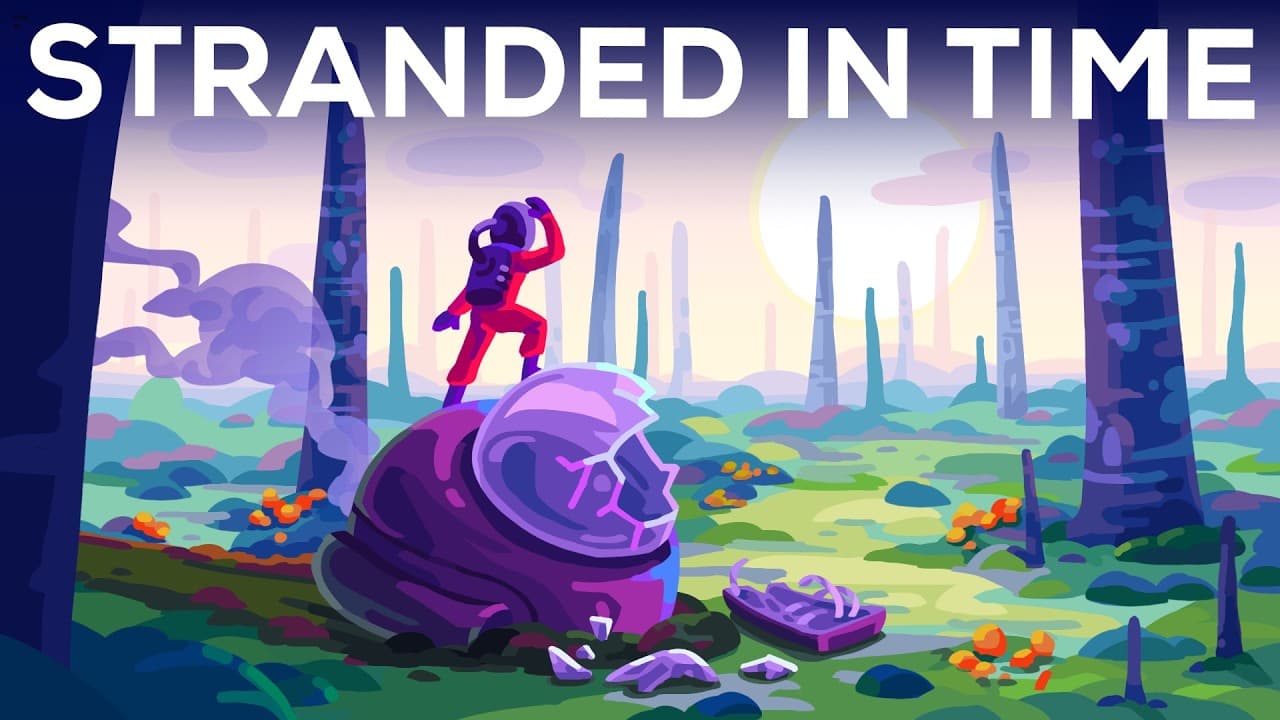
A broken time machine strands the traveler in various prehistoric periods, beginning with the early Triassic.
The early Triassic, 250 million years ago, was a 'hot house' era, a few million years after the worst mass extinction, with the planet suffering from a permanent fever caused by volcanism and a runaway greenhouse effect.
Atmospheric CO2 levels were 3 to 5 times higher than in the human era, leading to extreme heat and bone-dry air, easily reaching 50°C; the formation of the supercontinent Pangea created the largest desert in history, and the gigantic, superheated ocean lacked ice even at the poles, circulating extreme heat globally.
The desert core was moisture-starved, causing immediate skin drying, cracking lips, melting boot soles, and rapid skin cracking as sweat evaporated without cooling.
The vast, shallow Tethys Sea appeared as a murky, sickly, and milky swamp among scattered ferns and spindly stems; its water was as hot as a bathtub, and colorful bacterial mats floated on its surface.
The hot Tethys ocean held little oxygen, especially in deeper layers, fostering only bacteria and bivalves; breaking waves released a mist with a rotten egg stench of hydrogen sulfide from oxygen-starved depths, burning eyes and throat.
A massive storm, fed by the hot ocean's endless energy and unimpeded by continents, built on the horizon, dwarfing modern hurricanes.
The late Carboniferous, 320 million years ago, featured a never-ending wet 'super summer' without seasons, where colliding continents were covered by vast swamps and an endless alien jungle of giant treelike plants and ferns.
The dense plant cover supercharged the atmosphere with 60% higher oxygen levels than in the human era, making breathing dizzying for the time traveler but ideal for dominant land animals.
This was the 'golden age of arthropods,' where high oxygen levels enabled insects to evolve to immense sizes, including cat-sized mega-crabs, meter-winged griffin flies, car-length arthroplura, and predatory scorpions like the Pulmonoscorpius.
Extreme humidity created sudden, violent thunderstorms, and the oxygen-rich atmosphere made everything dangerously flammable, with even wet vegetation capable of explosive combustion from a slight spark.
The early Devonian, 400 million years ago, was a period of planetary transition where shallow seas covered much of Earth, and land consisted mainly of rocky plains and mountains with braided rivers and mud flats.
Over about 100 million years, life had begun breaking down rocks into soil, enabling plant growth, and organisms were slowly building up the ozone layer, accelerating the land's transition from toxic to semi-habitable.
The sky appeared unfamiliar, with a harsh, white sun barely filtered by the thin atmosphere, which contained only 15% oxygen, making each breath shallow and unsatisfying, bordering on passing out.
Massive fungal Prototaxites, reaching up to 8 meters high, dominated the landscape, with spores drifting like tiny stars and coating the skin with an itchy film, alongside carpets of smaller fungi and primitive plants.
The ground was mostly rock with a thin, springy layer of decomposing matter, and between the fungal towers, only small fungi and primitive, ankle-high plants grew; animal life was sparse, limited to a few insects, and the environment was eerily quiet.
Brilliant offers interactive, bite-sized lessons in math, logic, science, and technology, designed to transform one's mind into a problem-solving tool by building real skills through discovery.
The Kurzgesagt shop provides scientifically accurate and visually stunning posters, such as one depicting a blue giant becoming a black hole, with purchases directly funding the creation of their videos.
One of the most hostile environments Earth has ever produced.
| Subject | Category | Key Feature | Significance/Impact |
|---|---|---|---|
| Early Triassic Hot House | Prehistoric Climate/Environment | Extreme global heat (50°C+), 3-5x CO2, largest desert (Pangea), superheated oceans, no polar ice. | One of Earth's most hostile environments, a few million years post-mass extinction, barely supporting life. |
| Late Carboniferous Wet Summer | Prehistoric Climate/Environment | Never-ending wet 'super summer,' vast swamps, 60% higher oxygen atmosphere, dense plant cover. | Golden age of giant arthropods, highly flammable atmosphere, violent thunderstorms due to humidity. |
| Early Devonian Transition Period | Prehistoric Climate/Environment | Thin 15% oxygen atmosphere, land becoming semi-habitable, massive fungal Prototaxites (up to 8m). | Life initiates rock breakdown into soil, slow ozone layer buildup, alien and sparse terrestrial life forms. |
| Brilliant Educational Platform | Education & Skill Development | Interactive, bite-sized lessons in math, logic, science, and technology (AI, data analysis). | Transforms thinking, builds problem-solving skills, promotes learning through discovery, offers free trial and discount. |
| Kurzgesagt Shop Merchandise | Science Communication & Support | Scientifically accurate, visually stunning posters and sciency items (e.g., stellar experiments). | Funds video production, offers tangible connection to scientific concepts and astrophysical processes. |