
1 Nov 2025
Niroo Motor Company has implemented significant price increases across many motorcycle models, with examples like the G200 rising from 260 to 320 tomans, which are questioned despite company justifications of ABS, global transport, and raw material costs. This situation reflects deeper economic issues, manipulative market tactics, and predatory lending practices, driving consumers towards a future dominated by second-hand and Chinese products.
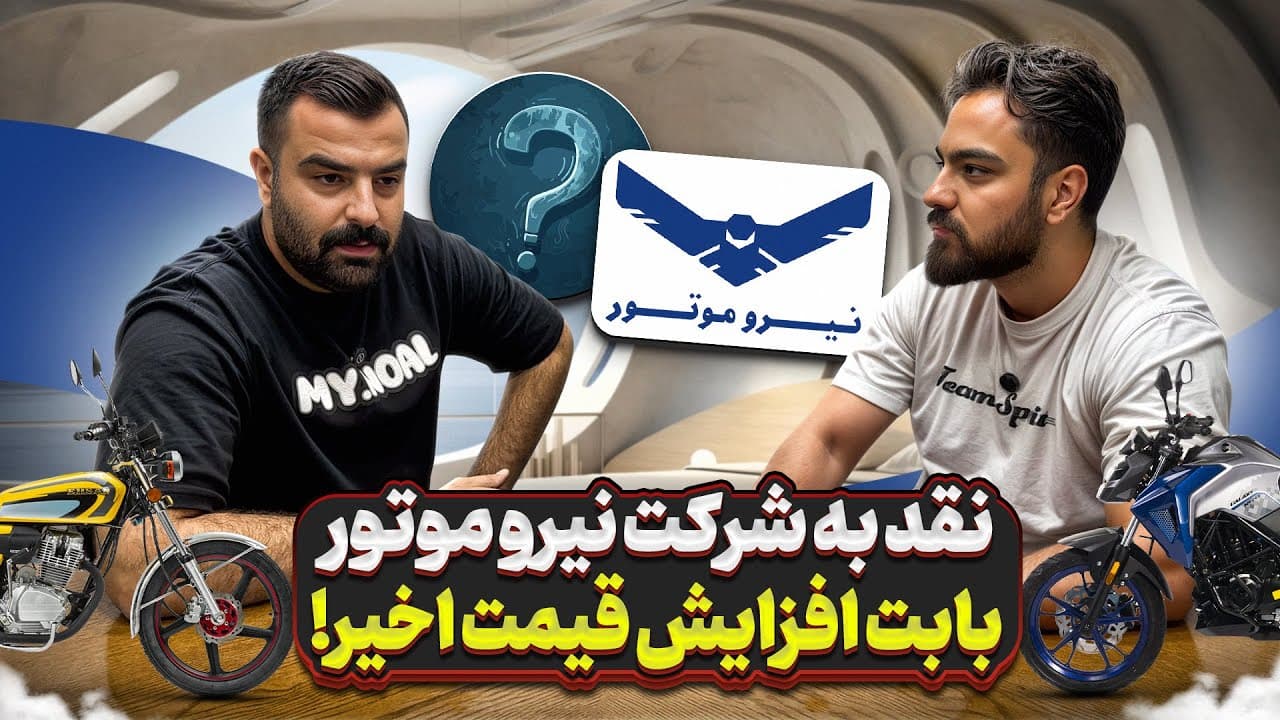
The Motahaz episode, featuring Mr. Reza, analyzes the significant price increases by Niroo Motor Company within the Iranian motorcycle market and the broader socio-economic challenges impacting consumers.
Niroo Motor Company has substantially increased prices for various motorcycle models, with the G200 rising from 260 to 320 tomans, and other models like the XSR and MT15 experiencing 100 toman hikes, even for versions without ABS.
Niroo Motor Company publicly attributes these price increases to mandatory ABS integration, rising global transportation costs, increased raw material (metal) prices, and the compulsory addition of daylight running lights on all motorcycles.
The speakers question the company's justifications, noting that some motorcycles already possessed features like CBS or daylight, and that price increases apply to stock purchased up to 18 months prior, predating some of the cited cost factors.
Niroo Motor Company initially removed popular models such as G200, EDI V, Joy Max, Jiti, and Yamaha from its catalog, only to reintroduce them later at significantly higher prices, simultaneously pushing less desirable models. A recent circular on November 2, 2015, brought all products back into the catalog but with steep prices and challenging credit terms.
The market is increasingly dominated by installment purchases and loans, often featuring high effective interest rates exceeding 40%, which are presented as advantageous but act as predatory schemes where banks utilize customer deposits for internal lending.
Banks engage in self-lending by holding customer funds for extended periods and offering 'credit' for specific products rather than direct cash, making repayment difficult and exploiting consumer financial illiteracy with convoluted loan agreements.
The economic situation and the constant pressure of loan payments divert public attention from broader political and social issues, diminishing the capacity for collective action or protest against market injustices.
The Iranian motorcycle market experienced a 'renaissance' from 2006 to 2016 with the introduction of new brands like Benelli and better-quality imports, following a period (pre-2006) of limited options and reliance on low-quality models like the CDI 86.
The market is predicted to exit this renaissance, returning to a reliance on cheaper Indian and Chinese products as established brands (e.g., Honda, Yamaha) become luxury items due to challenging economic conditions and import restrictions.
Consumers are advised to avoid purchasing new (zero-kilometer) motorcycles due to high prices, rapid depreciation, and market volatility, instead considering the more stable second-hand market or investing in rebuilding existing vehicles as a financially sound alternative.
There is frustration with consumers who impulsively buy expensive new motorcycles, often incurring significant personal loss, without adequate financial calculation or understanding of market dynamics, contributing to a cycle of quick resale and depreciation.
A 'zero-buy campaign' is proposed to collectively resist inflated prices and compel companies to adopt more reasonable pricing strategies, emphasizing that collective consumer behavior can significantly influence market outcomes.
As the Iranian motorcycle market shifts from a renaissance towards reliance on Chinese products and a robust second-hand category, intelligent consumer choices are paramount to navigate the compounded challenges of unchecked price hikes and predatory financial schemes.
| Insight | Detail |
|---|---|
| Motorcycle Price Inflation | Niroo Motor Company significantly increased prices across various models, with the G200 rising from 260 to 320 tomans, and other models like XSR and MT15 seeing 100 toman hikes. |
| Questionable Company Justifications | Official reasons such as mandatory ABS, global transport, raw material costs, and daylight lights are challenged as many products either already had these features or were purchased prior to these cost increases. |
| Market Manipulation Tactics | Popular motorcycle models were temporarily removed from catalogs, creating scarcity, then reintroduced with inflated prices and restrictive credit options, while less desirable stock was pushed. |
| Predatory Loan and Installment Schemes | Installment plans often feature effective interest rates exceeding 40%, and banks engage in self-lending using customer deposits, offering 'credit' for specific products rather than direct funds. |
| Shift to Second-Hand and Chinese Market | The 'renaissance' of quality brand motorcycles is ending, leading to increased reliance on cheaper Indian/Chinese products and a growing, more stable second-hand market. |
| Recommended Consumer Action | Consumers should avoid buying zero-kilometer motorcycles due to high prices and rapid depreciation; exploring the second-hand market or investing in rebuilding existing vehicles is more sensible. |
| Call for Collective Consumer Resistance | Initiating a 'zero-buy campaign' for new motorcycles is suggested to collectively push back against inflated prices and influence market adjustments towards fairer pricing. |