

16 Oct 2025
Augmented Vertex Block Descent (AVBD) is a new, free, and open simulation method that solves previously impossible problems in physics simulation with high accuracy and speed. This technique demonstrates robust performance across complex scenarios where prior methods experienced significant failures.
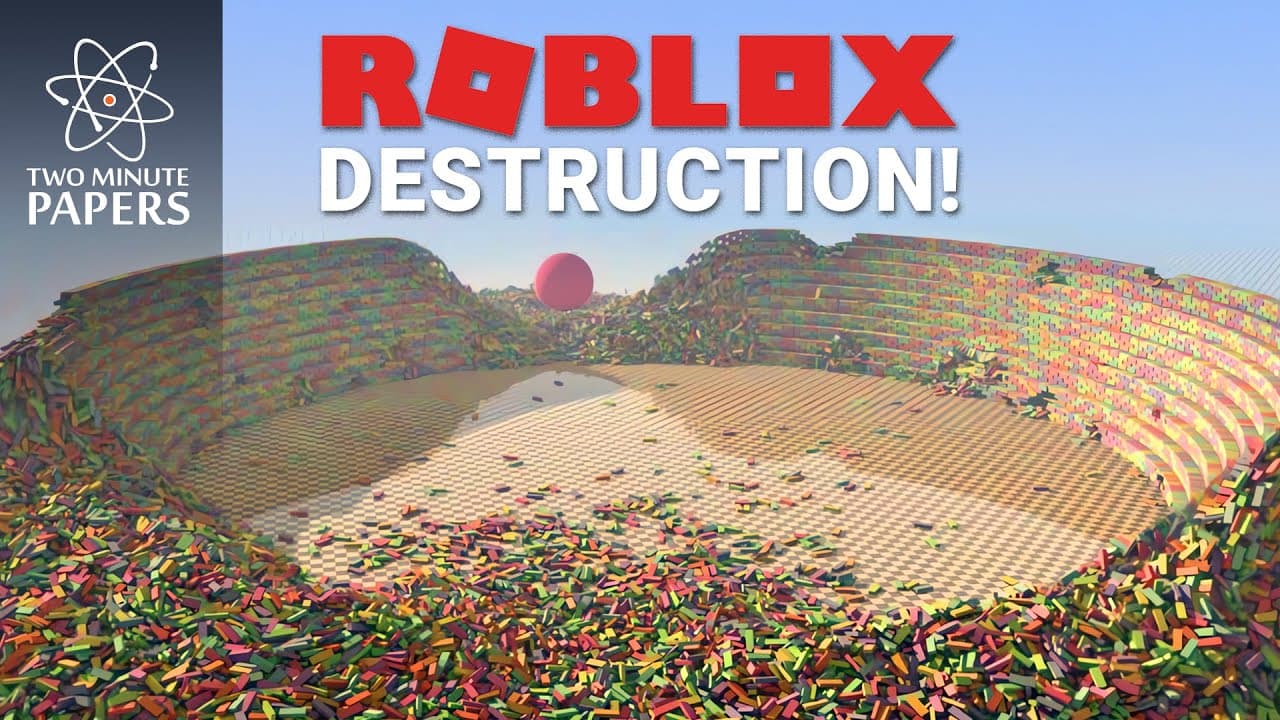
Augmented Vertex Block Descent (AVBD) is an amazing new, free, and open simulation method that solves previously impossible problems in physics simulation.
A collaboration between Roblox and the University of Utah allows the simulation of complex scenes easily faster than real-time, achieving 100 frames per second on one consumer graphics card.
Vertex Block Descent (VBD), a previous version, could simulate incredible scenes modeled as interactions of millions of points, but it was not perfect and failed in several baffling cases.
The number of iterations refers to the computational effort spent on each frame to achieve accurate simulation results, with higher iterations improving accuracy but requiring longer waiting times.
The previous method incorrectly simulates rolling balls at a house of cards due to an excessive amount of friction, regardless of the number of iterations used.
Old methods completely break down when simulating a simple pendulum where the ball's mass is 50,000 times higher than the chain, causing the chain to stretch excessively like gum.
The new Augmented Vertex Block Descent technique provides a rock-solid and correct solution for the pendulum problem, successfully handling the extreme mass ratio without stretching.
Previous methods incorrectly simulate a ball thrown through chain mail because collision constraints cannot overcome the ball's momentum, despite chain mail being designed to hold the ball.
The new method effectively simulates a ball interacting with chain mail, correctly demonstrating its ability to hold up the ball.
Even simple arrangements of blocks connected by springs pose a challenge for the previous method, which shows significant sagging even with 100 iterations.
The new method achieves a near-perfectly straight arrangement for connected blocks with springs, even at 1 iteration, significantly outperforming the previous method at 100 iterations.
The 'augmented' part of Augmented Vertex Block Descent means it gradually adjusts how strictly it enforces rules during physics simulation, adapting its effort to the degree a rule is being broken, similar to a bouncer.
This significant improvement occurred in just one year, is powered solely by human ingenuity, and is available for free with source code, making it a great contribution to humanity.
It's the moment you realize even the 'simple' things weren't truly solved, until now.
| Aspect | PreviousMethodObservation | NewMethodObservation | Significance |
|---|---|---|---|
| Pendulum Simulation | Chain stretches excessively like gum when a heavy ball is attached to a light chain (50,000:1 mass ratio). | Remains rock-solid, providing the correct solution without excessive stretching. | Solves a fundamental problem previously considered 'simple' but challenging for old methods due to extreme mass ratios. |
| Ball Through Chain Mail | Collision constraints fail to overcome the ball's momentum, leading to incorrect penetration. | Successfully holds up the ball, accurately reflecting the physical properties of chain mail. | Correctly models complex material interactions and collision responses, where previous methods failed. |
| Connected Blocks with Springs | Shows significant sagging even after 100 iterations, failing to achieve a perfectly straight arrangement. | Achieves a near-perfect straight arrangement with just 1 iteration. | Demonstrates drastically improved efficiency and accuracy, outperforming previous methods at 100x fewer iterations. |
| Adaptive Rule Enforcement | (Implicit) Rigid enforcement of rules led to simulation failures in challenging scenarios. | Gradually adjusts how strictly it enforces physics rules during simulation, adapting to the degree of rule violation. | This 'augmented' mechanism is key to AVBD's robustness and accuracy across diverse physical challenges. |