
16 Oct 2025
Existing AI animation techniques frequently present a trade-off between physical viability and control, often failing to deliver both realistic and easily manageable motion. A new method called Diffuse-cloc overcomes this by generating controllable, realistic animations directly from a diverse pool of motion capture data, effectively resolving prior limitations.
Existing AI-based animation techniques either produce physically viable motion that is difficult to control or controllable motion that lacks realism, creating a dilemma for animators.
Classical animation techniques require artists to manually produce every single motion, a labor-intensive and time-consuming process.
A novel AI animation technique named Diffuse-cloc combines the best of both worlds, generating controllable and physically viable motion from a 'soup' of diverse motion capture data.
The new technique enables animated characters to autonomously avoid static obstacles like walls without explicit programming.
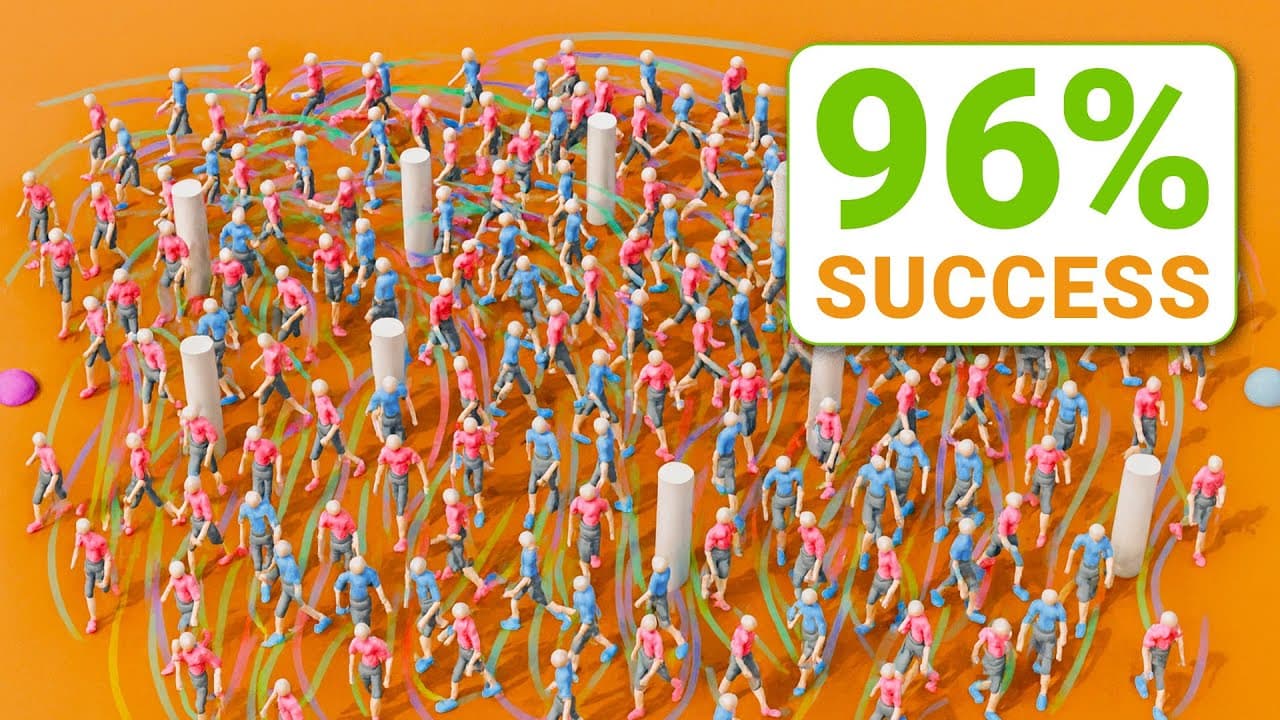
Characters animated with this method can effectively avoid collisions with other moving AI-controlled entities, even in complex and dynamic environments.
The Diffuse-cloc method efficiently handles and generates extended and continuous animation sequences.
The technique demonstrates powerful generalization, allowing characters to perform actions in novel situations they have not previously encountered, such as jumping over multiple unseen pillars.
Users can specify two or more target poses, and the method will seamlessly generate the motion transitions between them, a capability often absent in other diffusion-based AI techniques.
Animated characters exhibit significant resistance to external disruptions and perturbations, maintaining their intended movement despite interference.
The AI learns to weave unconnected input motions and utilize them in new situations, anticipating future movements rather than merely following predefined choreography.
The model can be trained on a single GPU within 24 hours, making it highly accessible and easy to deploy.
The model operates with zero-shot learning, requiring no retraining or task-specific tuning, and holds significant potential for creating naturally moving game characters, VR avatars, and robots.
This new AI is like teaching a dancer not just the steps, but also how to feel the rhythm a few seconds ahead - so every move already anticipates what comes next.
| Feature | Description |
|---|---|
| Controllable & Realistic Motion | Generates highly controllable and physically viable motion from diverse motion capture data, overcoming traditional trade-offs. |
| Static Obstacle Avoidance | Enables characters to autonomously navigate around fixed objects such as walls. |
| Dynamic Obstacle Avoidance | Allows characters to avoid collisions with other moving AI-controlled entities in dynamic environments. |
| Longer Animation Sequences | Successfully handles and generates extended and continuous animation sequences efficiently. |
| Generalization to Unseen Scenarios | Demonstrates the ability to perform novel actions in situations not encountered during training, like jumping over multiple pillars. |
| Pose Interpolation | Generates smooth and natural motion transitions between two or more specified poses, a unique capability for diffusion-based methods. |
| Resistance to Perturbations | Characters maintain their movement and stability even when subjected to external physical disruptions. |
| Efficient Training | The model can be trained quickly, requiring only a single GPU for 24 hours. |
| Zero-Shot Learning | Operates without needing retraining or task-specific tuning, adapting to various scenarios out-of-the-box for applications like game characters or VR avatars. |