

16 Oct 2025
A novel squishy simulation technique allows soft bodies to perform complex, physically realistic movements, addressing the challenges of animating objects without traditional skeletal structures. This method achieves unprecedented control over deformable characters, enabling capabilities previously impossible with older first-order optimization approaches.
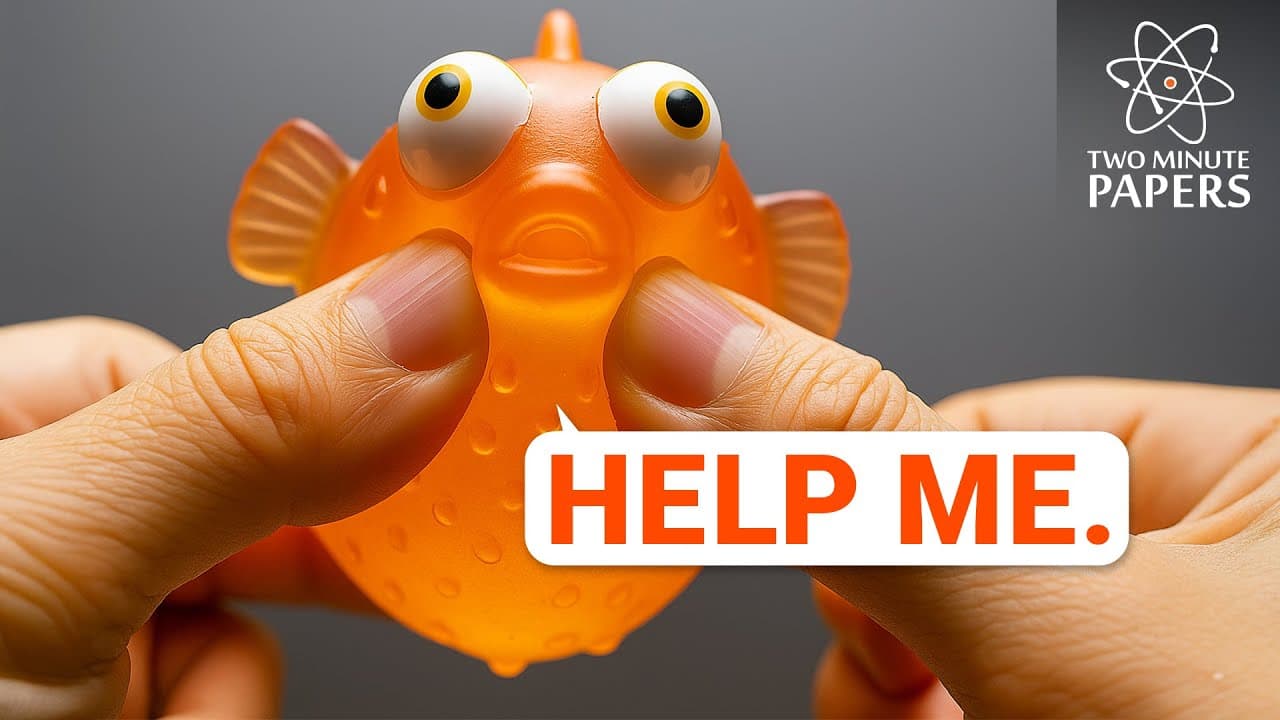
Animating characters that lack bone and joint structures, such as jellyfish or stress balls, is inherently difficult because their movement relies on squishing, stretching, and contracting their soft bodies. Simulating these actions requires determining a series of physically sensible muscle contractions and relaxations, which is computationally intense due to thousands of interacting parts, collisions, friction, and the absence of simple closed-form equations.
Older gradient descent-based methods struggle significantly with complex dynamic tasks, like launching a ball into a hoop, demonstrating their inability to effectively control intricate soft-body physics. These first-order methods lack the comprehensive understanding of the movement landscape necessary for precise and consistent outcomes.
A new squishy simulation technique consistently achieves complex soft-body movements that were previously considered impossible, marking a substantial advancement over prior methods. This innovative approach provides a level of control that transforms how soft, deformable objects are animated, overcoming previous limitations.
The new method enables realistic crawling for starfish, lifelike wriggling for gummy caterpillars, complex acrobatics such as backflips for lamps, and hopping movements for chess pieces. It can also animate a personal butler, showcasing its versatility in creating dynamic and interactive soft-body simulations with incredible realism.
The technique combines automatic differentiation for precise slopes with a clever complex-numbers probe that uses a microscopic step in an imaginary direction to cleanly read curvature. This 'mixed second-order differentiation' provides the essential information for true Newton updates, equipping the optimizer with a comprehensive 'map and compass' for movement.
Gradient descent operates by feeling the local slope and taking cautious steps, whereas Newton’s method not only senses the slope but also how the ground curves, allowing it to 'leap' to the correct spot much quicker. The primary challenge lies in quickly and accurately measuring this curvature within a complex soft-body environment that includes contacts and friction.
Currently, computing one second of movement with this technique typically takes 10 to 25 minutes, meaning it is not yet real-time. However, this performance is suitable for movies and, with anticipated future advancements, will likely be within reach for video games. The technique makes previously impossible animations possible, with ongoing efforts focused on increasing its speed for interactive applications.
This paper signifies the birth of a new animation paradigm where soft, squishy worlds are no longer merely puppeteered but exhibit truly realistic and rich movements. It offers a glimpse into creatures moving with the complexity and nuance of real life, representing a brilliant and groundbreaking advancement in the field.
This isn’t just eye candy - it’s a glimpse of creatures that move with the richness of real life.
| aspect | gradientDescent | newMethod |
|---|---|---|
| Core Principle | Feels local slope, takes cautious steps (first-order optimization). | Senses slope and ground curvature, enabling quicker 'leaps' (based on Newton's method). |
| Information Utilized | Relies on local slope information to guide movement. | Combines precise slopes from automatic differentiation with curvature readings from a complex-numbers probe. |
| Soft-Body Control | Struggles with complex soft-body dynamics and fails at intricate tasks. | Consistently achieves complex, physically realistic movements with unprecedented control. |
| Animation Examples | Unable to launch a ball into a hoop. | Enables starfish crawling, gummy caterpillars wriggling, lamps doing backflips, and chess pieces hopping. |
| Computational Time | Not specified, but generally faster for simpler, less precise tasks. | Currently 10-25 minutes per second of movement; suitable for movies, aiming for real-time games. |
| Overall Significance | Offers limited realism for non-skeletal characters. | Marks the birth of a new animation paradigm, achieving truly realistic and rich soft-body movements. |