
16 Oct 2025
The pervasive issue of digital objects clipping through each other in gaming and film, often requiring extensive manual correction, has been a significant challenge in computer graphics. A novel research paper introduces a "cubic barrier" method, combined with an efficient iterative solver, that enables highly accurate and stable collision detection for millions of contacts, virtually eliminating clipping for thin objects.
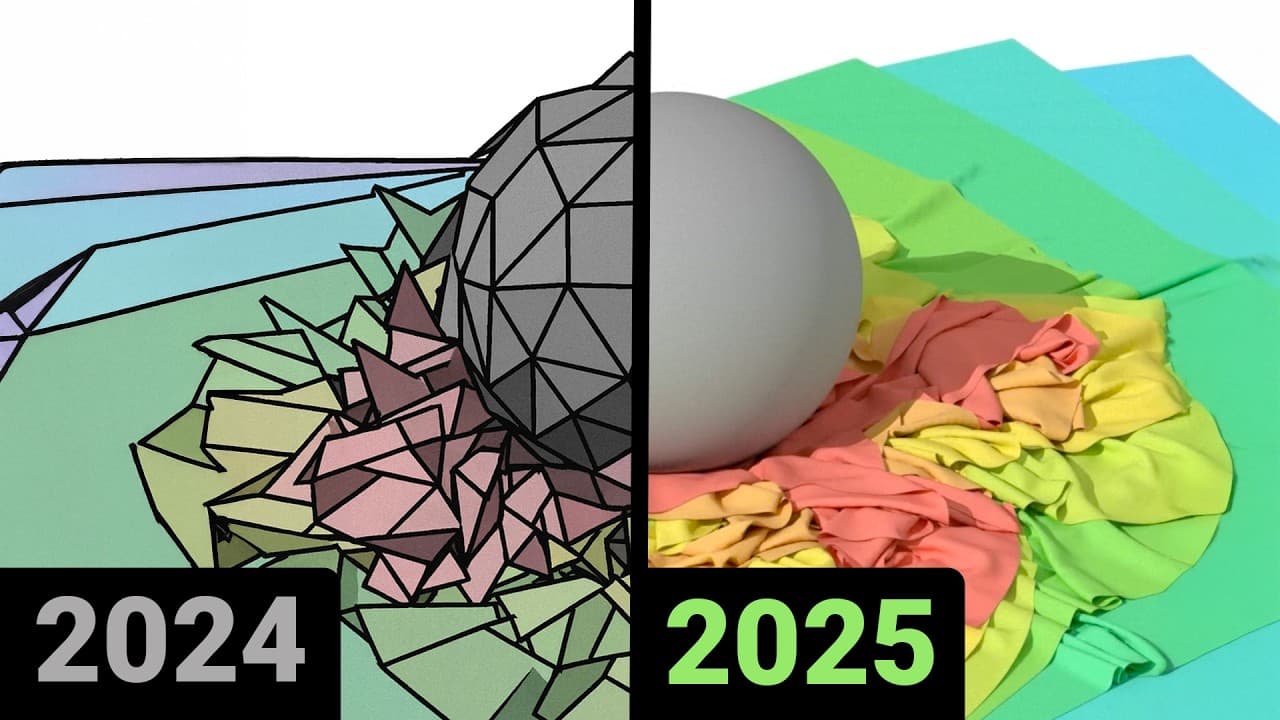
Digital objects frequently clip through each other in gaming, creating bugs exploited by speedrunners, and in movies, requiring extensive manual correction by VFX artists.
Clipping occurs when the geometry of thin digital objects, such as cloth, ribbons, or noodles, touch in the digital world, often leading them to pass through or get stuck.
A new, freely available research demonstrates a solution that can simulate millions of collisions involving objects like noodles, ribbons, and spheres without any objects slipping through.
The research showcases robust collision handling for extreme scenarios, including millions of noodles, crushing ribbons with up to 168 million collisions, and detailed simulations of squishy spheres and armadillos.
The technical demonstration of this incredible simulation is available for exploration by technically inclined individuals through a provided link.
The complex research paper, initially aimed at experts, is simplified for broader understanding, revealing that the solution relies purely on human ingenuity, not AI, as presented by Dr. Károly Zsolnai-Fehér.
The system takes the geometry (mesh) of objects as input and produces a simulation where millions of contacts happen without any objects ever overlapping or fusing, akin to juggling thousands of glass marbles without collision.
The method allows for extreme manipulation of cloth, such as twisting it into oblivion, while maintaining exceptional accuracy and stability, even under close inspection.
This new technique replaces the old 'logarithmic barrier' trick, which often freezes when objects get very close, with a 'cubic barrier' that eases into collisions using a smoother force curve. It creates a dynamic elastic bubble between surfaces, allowing them to slide gracefully past each other.
The paper employs a '3x3 Jacobi block preconditioned Conjugate Gradient method,' an efficient iterative approach to solve the massive mathematical equations that describe all forces and movements. This method breaks down complex interactions into smaller groups and refines instructions quickly, ensuring harmonious movement without full recalculations.
The OGC technique improved collision detection by adding a tiny offset layer around objects; however, it struggled with extremely tiny gaps or millions of simultaneous contacts, particularly with thin shells.
The cubic barrier method actively adjusts its stiffness using the material’s own elasticity, maintaining even microscopic gaps. It functions like a memory foam cushion, adapting dynamically to prevent tearing, unlike OGC's fixed safety cushion.
This advanced simulation runs on a single graphics card, though it requires patience, with computation times in minutes per frame.
The research is a single-author paper by Dr. Ryoichi Ando, previously known for his adaptive fluid simulations that concentrate computation where action occurs.
The paper was published by Zozo, a Japanese fashion e-commerce giant, at SIGGRAPH Asia, driven by their ambition to automate clothing production, which requires accurate simulation of fabric behavior without clipping to reduce waste and accelerate design.
This research is a stepping stone toward less wasted fabric, faster fashion design, automated digital tailoring, and allows for virtual cloth fitting without physical try-ons.
While highly accurate, the method is currently slow, operating at a pace comparable to watching paint dry or an orchestra playing one note per minute.
This significant technical wizardry, freely available, holds the potential to revolutionize industry practices but is currently not widely discussed, risking its impact being overlooked.
This new cubic barrier method doesn’t just wrap things - it actively adjusts its stiffness using the material’s own elasticity, so it can keep even microscopic gaps open.
| Aspect | Description |
|---|---|
| Problem Solved | Eliminates objects clipping through each other in digital simulations, a long-standing issue in gaming, VFX, and material simulation. |
| Core Innovation | Introduces the "cubic barrier" method, which smoothly handles object proximity and collisions with adaptive elasticity, surpassing older "logarithmic barrier" techniques. |
| Computational Method | Employs a "3x3 Jacobi block preconditioned Conjugate Gradient method" for efficiently solving the massive mathematical equations governing object interactions. |
| Key Advantages | Achieves exceptional accuracy and stability, handling up to 168 million collisions without penetration; operates efficiently on a single graphics card. |
| Comparison to OGC | Superior to the Offset Geometric Contact (OGC) method by actively adjusting stiffness based on material elasticity to maintain microscopic gaps, rather than using a fixed offset layer. |
| Real-world Application | Enables automated clothing production, faster fashion design, and precise digital tailoring by accurately simulating fabric behavior without clipping, as pursued by Zozo. |
| Current Limitation | The method is highly accurate but currently slow, requiring minutes per frame for complex simulations. |
| Author & Contribution | Authored by Dr. Ryoichi Ando in a single-author paper, highlighting a significant individual scientific contribution to the field. |