

25 Oct 2025
Current 'image-to-3D' models struggle with fused clothes and bodies, preventing realistic physical simulation and leaving true digital fashion out of reach. A new method from UCLA and the University of Utah now reconstructs physically accurate, simulation-ready clothes, separated from the 3D human, from a single photo, addressing a significant challenge in virtual human modeling.
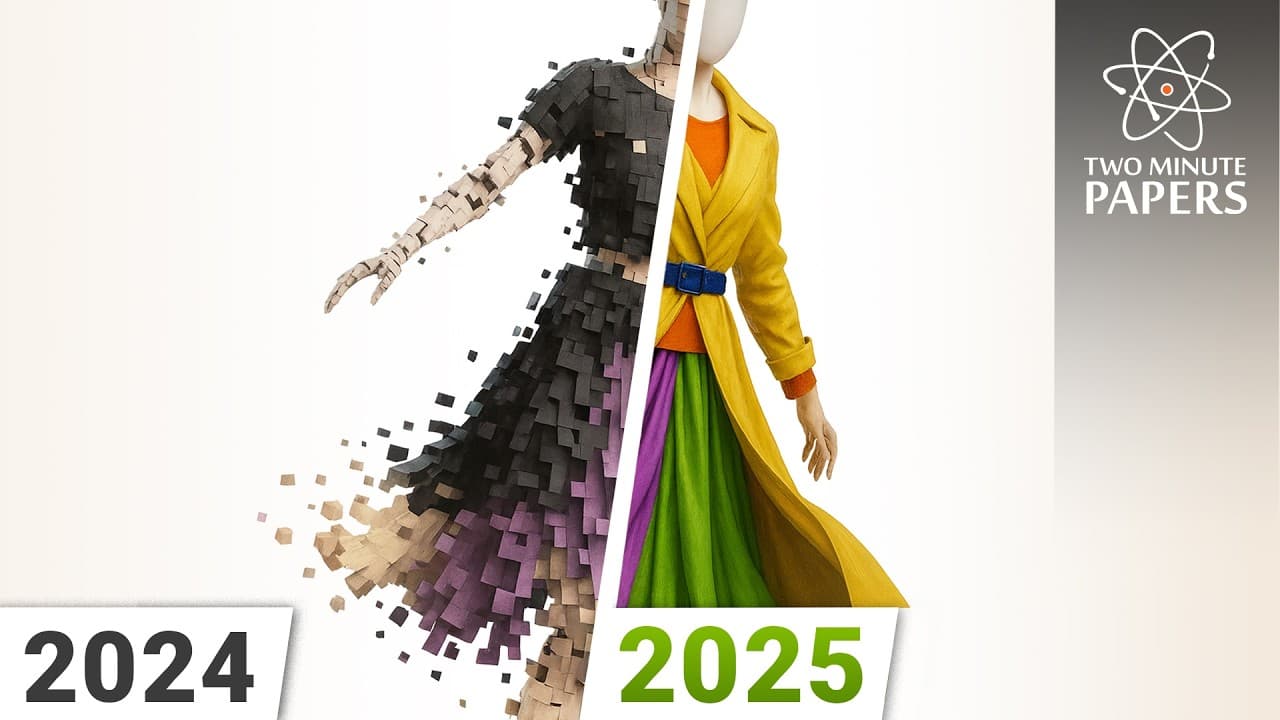
Older "image-to-3D" models produce rough 3D person reconstructions where clothes and the body are fused into one piece, preventing realistic garment movement and leading to unrealistic appearances.
Without separation between the body and clothes, physical simulation is impossible, meaning garments cannot flutter, wrinkle, or react realistically to character movements like spins.
The goal of true digital fashion involves physics-ready, wearable, separable garments, a capability that has largely remained unachieved until recently.
A new paper from UCLA and the University of Utah presents a method that reconstructs not just a 3D human from a single photo, but also physically accurate, simulation-ready clothes that are separated and ready to move.
Reconstructing separable, simulation-ready garments is considered one of the hardest problems in virtual human modeling, involving significant challenges in geometry, physics, and AI simultaneously.
The system begins by taking an input image and guessing an initial sewing pattern, functioning like a digital tailor that cuts fabric pieces based on visual input.
The initial process of throwing flat panels onto a 3D human model often results in significant inaccuracies, with clothes being ill-fitted and incorrectly shaped.
To correct initial fitting issues, the system uses differentiable physics and multi-view diffusion guidance to refine the shapes of the sewing panels, adjusting curves and seams to better match the simulated garment to the character.
After shape refinement, the system re-examines the input image to paint the correct material and color onto the 3D garment, completing the visual reconstruction.
The AI component utilizes multi-view diffusion guidance, which allows the model to imagine and sketch a subject from every angle based on a single input picture, ensuring a consistent and accurate 3D shape.
The human ingenuity part employs Codimensional Incremental Potential Contact (CIPC), an optimization-based cloth simulator that minimizes total system energy to find the most comfortable resting position for the fabric.
CIPC's mathematical framework includes terms that keep the cloth in its intended position, ensure elasticity and proper bending, and a barrier term that prevents clothes from penetrating the body.
The physics model is fully differentiable, enabling the AI to "feel" inaccuracies and learn how to pull or stretch each seam to make instant adjustments, similar to a tailor feeling the fabric.
Multi-view diffusion informs the system about the desired visual appearance, while CIPC dictates how the garment should physically behave, combining to create simulation-ready digital outfits from single images.
The method struggles with "out-of-distribution" fashion, such as exotic or unusual garments like feather jackets or jellyfish costumes, often producing less accurate results.
The work is attributed to renowned computer graphics experts, including those behind the Incremental Potential Contact (IPC) model, which prevents digital fabrics from clipping through bodies and ensures stable physics-based animation.
The system can re-sew and correct garment issues mid-process, automatically pulling back tangled cloth meshes, ironing them out, and refitting them onto the digital body, preventing common simulation explosions.
The entire reconstruction process takes approximately two hours, a significant improvement over previous impossibilities, and can run on a single RTX 3090 GPU without system collapse.
From a single photo, physically accurate, simulation-ready clothes, separated and ready to move, can be reconstructed, overcoming a major challenge in virtual human modeling.
| keyInsight | details |
|---|---|
| Previous Limitation | Image-to-3D models fused clothing to the body, preventing realistic physics simulation and separate garment movement. |
| Core Innovation | Reconstructs physically accurate, simulation-ready, separable 3D garments from a single photo. |
| AI Component | Multi-view diffusion guidance synthesizes views from all angles to establish consistent 3D shape. |
| Physics Component | Codimensional Incremental Potential Contact (CIPC) optimizes fabric behavior by minimizing total system energy and preventing body penetration. |
| Refinement Mechanism | Differentiable physics allows the AI to learn and adjust seam and shape inaccuracies instantly. |
| Self-Healing Feature | The system can re-sew and re-fit tangled cloth meshes mid-simulation, avoiding common catastrophic failures. |
| Process Time & Hardware | The full reconstruction takes about two hours and is achievable on a single RTX 3090 GPU. |
| Current Weakness | The method struggles with "out-of-distribution" or exotic fashion designs. |