
16 Oct 2025
Life on Earth exhibits incredible diversity, thriving in the strangest and most extreme environments, from blue dragon sea slugs to iron-shelled snails. Leveraging imagination and scientific principles, the exploration journeys to three distinct exoplanets, revealing wonders of life uniquely adapted to vastly different cosmic conditions.
Life on Earth is incredibly diverse, existing in extreme places, including blue dragon sea slugs, aye-ayes, and Chrysomallon snails with iron shells.
Oculus is a red dwarf star, five times smaller and much less bright than our Sun.
Ipa, orbiting Oculus 20 times closer than Earth to the Sun, is a tidally locked planet with one side experiencing eternal night and the other eternal day. Its warm, pleasant region facing the dim star has melted into a shallow black ocean called the Eye of Ipa, which is about the size of Europe and churned by a never-ending storm.
Below the inhospitable storm of the Eye of Ipa lies a calm, stable ecosystem resembling a floating underwater jungle, similar to kelp forests on Earth. The plants here are deep black to absorb weak infrared wavelengths from Oculus, giving the ocean its striking black color.
Ipa hosts streamlined, teardrop-shaped grazers resembling fish, which lazily consume leaves. Predators exist, adapted with camouflage, and both hunter and prey lack eyes, relying instead on sounds and textures for interaction within a cacophony of chattering Seed-Eaters, squeaking Spike-Bulbs, and flailing Grabbers.
Blind Creepers are creatures noticed by visitors, crawling towards them, indicating a need to leave the world.
Caeruleus is a hot, blue B-type star, orbited by numerous lava planets, and showers its last planet, Nimbus, with 900 times more light than Neptune receives.
Nimbus is a gas giant similar to Neptune in size and composition but with abundant water. Its atmosphere is warm enough to support gigantic, country-sized white clouds lofted by titanic updrafts, where life first emerged and evolved rapidly.
Life on Nimbus originated deep within tiny water droplets, with microbes breathing methane and using exotic enzymes to harvest sulfur and nitrogen compounds, later spreading to higher altitudes as Caeruleus grew hotter.
Quadrillions of tiny cloud plankton, resembling flat, four-legged spiders, exist in Nimbus's clouds. They are tinted yellow from consumed sulfur and gain lift using wispy electrostatic threads, similar to Xysticus crab spiders on Earth.
During mating season, billions of cloud plankton gather, joining their threads into huge parachutes that ride updrafts for hundreds of kilometers to hatch eggs in the hot heights before their life ends.
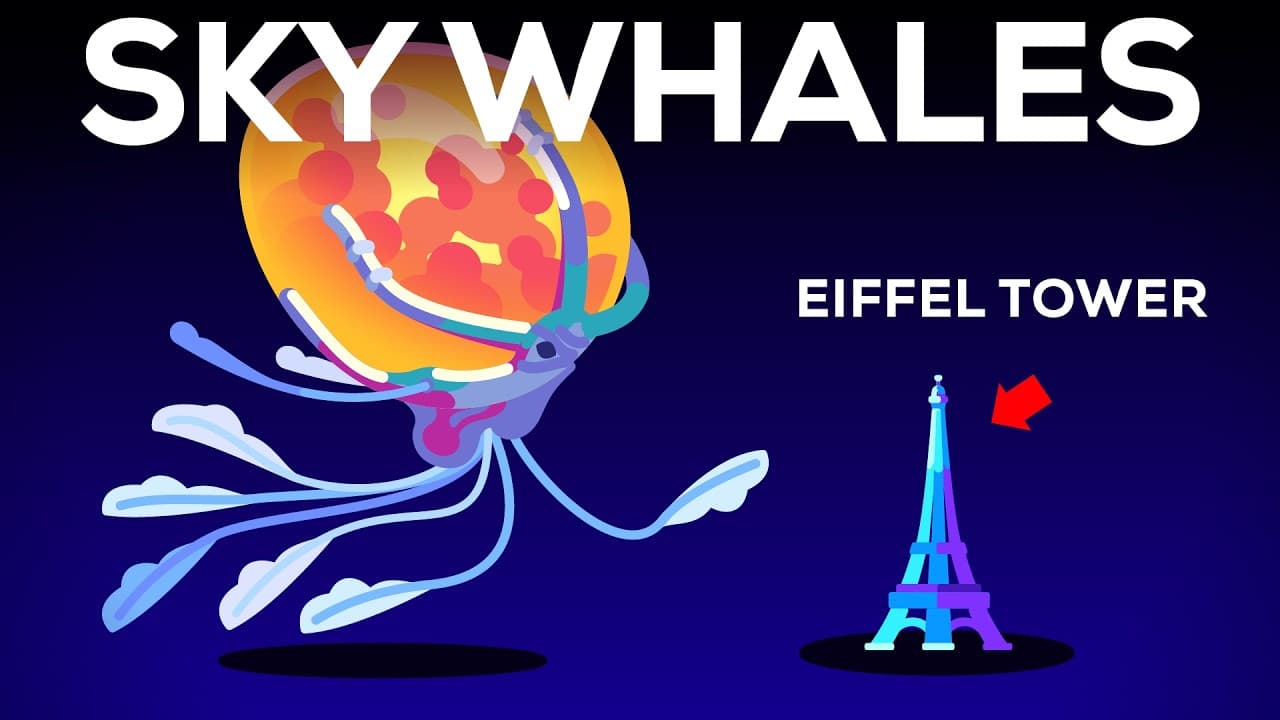
Enormous Sky Whales, taller than skyscrapers, are living balloons composed of a wafer-thin membrane. They achieve buoyancy by heating trapped gases and feed by unfolding a huge sticky net to filter sky plankton, converting some into an energy-dense orange nectar.
Jet Squids, frog-sized evolutionary cousins of Sky Whales, are less efficient floaters but can superheat and expel gases in short bursts for propulsion. They are predators that use long, pointy beaks to pierce Sky Whales and consume their valuable nectar.
Life on Nimbus is doomed, as B-type stars like Caeruleus have short lifespans of a few hundred million years, and this ecosystem, only 600 million years old, has barely ten million years left before its star violently burns the gas giant.
Orsted is a Y-class brown dwarf, 13 times more massive than Jupiter, possessing a magnetic field 60 times stronger, and orbits the yellow star Sturgeon.
Monnier, a moon of Orsted, receives as much sunlight as Earth but has extremely short, three-hour days due to its rapid orbit. Its low gravity (5% of Earth's) only retains a thin carbon dioxide atmosphere that does not hold much heat, leading to average temperatures far below freezing and dry ice snow during its cold nights.
Monnier's landscape is illuminated by green, blue, and red auroras, formed by star plasma caught in Orsted's magnetic field striking the moon's atmosphere.
Life on Monnier evolved in a frigid, mineral-rich environment, using ammonia instead of water (which would freeze) and incorporating magnetized minerals and Orsted's extreme magnetic field into its biology for survival.
Monnier's plants, called skyflowers, unspool and climb towards the rising Sturgeon. Their blossoms are saturated with magnetic minerals, allowing them to levitate up to a kilometer into the sky to extend exposure to sunlight due to low gravity and extreme magnetism.
Shiny, ice-skating snail-like critters called Skaters circle Monnier faster than the sunset. They extend two electrically-conductive stalks that merge at the top, forming a magnetic kite that propels them across the surface, in a symbiotic relationship with photosynthetic purple microorganisms in their shells.
Ambushers are creatures resembling a cross between a sea-lion and a beetle that hide in the crystalline ground. They spread electrically sensitive whiskers to detect prey like Skaters and strike with spiked metal claws, devouring them and getting covered in pink, sparkly fluids.
Scientific speculation about alien life is both entertaining and valuable, generating ideas for what to look for and potentially guiding future human exploration of exotic cosmic environments.
Brilliant offers thousands of hands-on, bite-sized lessons in physics, AI, mathematics, and data analysis to enhance thinking and problem-solving skills, allowing users to learn through discovery and apply concepts to real-world situations.
Kurzgesagt has partnered with Brilliant to create a series of lessons that expand on popular video topics like black holes, supernovae, climate science, and viruses, offering a personalized learning experience.
Kurzgesagt offers special science-themed posters and other merchandise through their shop, with every purchase directly funding the creation of more video content, enabling their channel's continued operation.
Scientific speculation is not only fun but also useful, providing ideas about what to look for and inspiring future exploration of exotic oceans, continental clouds, or metallic animals.
| World | Star/Body | Key Environmental Feature | Unique Life Trait | Survival Mechanism |
|---|---|---|---|---|
| Ipa | Oculus (Red Dwarf) | Tidally-locked, shallow black ocean (Eye of Ipa), never-ending storm. | Black photosynthetic plants for infrared light, sound-based senses. | Ecological balance in calm depths, camouflage for predators, sound-based communication/hunting. |
| Nimbus | Caeruleus (B-type Star) | Gas giant with gigantic, country-sized white clouds, high radiation. | Cloud plankton (electrostatic lift), Sky Whales (living balloons). | Buoyancy via heated gas, filter-feeding on cloud plankton, short evolutionary lifespan due to star's short life. |
| Monnier | Orsted (Brown Dwarf moon) | Low gravity, strong magnetic field, thin CO2 atmosphere, ammonia-based solvent. | Metallic biology, levitating skyflowers, magnetic propulsion (Skaters). | Utilizing magnetic fields for propulsion and levitation, symbiotic relationships for energy, ambush hunting. |