
15 Oct 2025
NVIDIA introduces the DGX Spark, a compact AI supercomputer designed to run complex AI models locally, even outperforming some high-end consumer setups in specific scenarios. This device represents a new category of affordable AI servers, promising powerful local AI capabilities that could significantly impact development workflows.
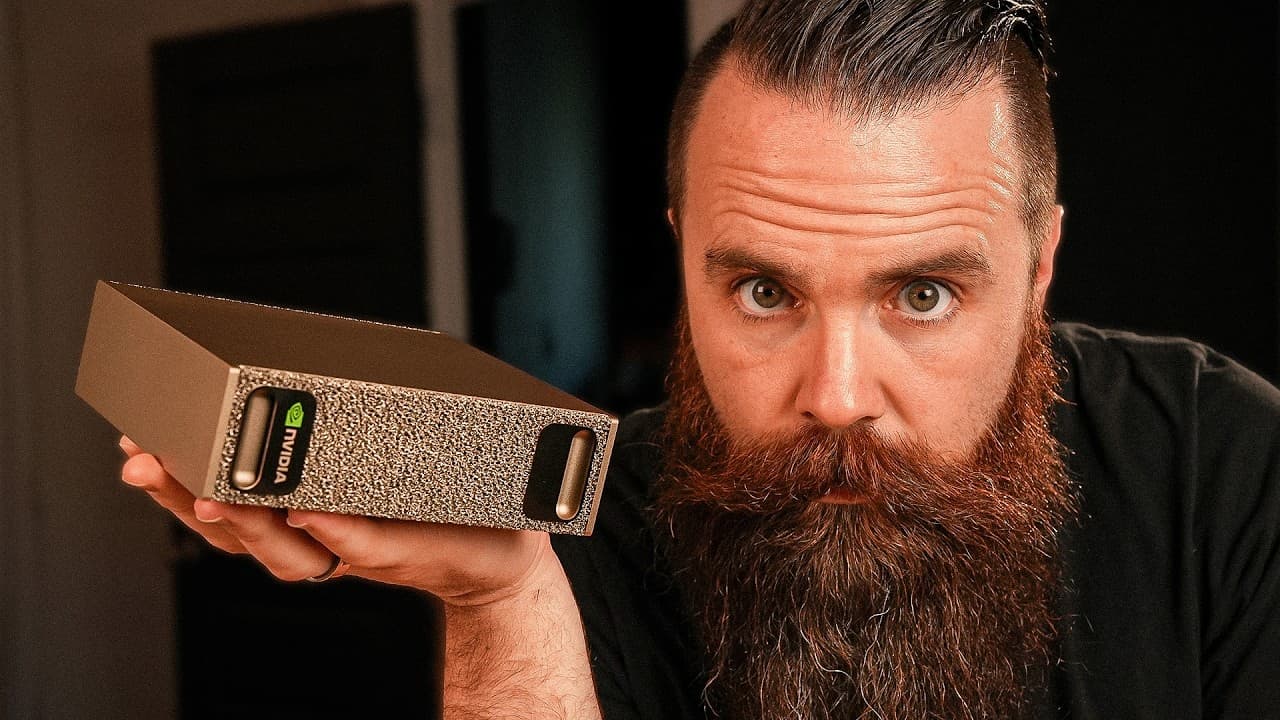
The NVIDIA DGX Spark is an AI supercomputer that fits in the palm of a hand and is capable of running AI models that high-end dual 4090 consumer GPUs cannot, establishing a new category of affordable local AI servers.
The DGX Spark is significantly smaller than the original DGX-1 server, which was instrumental in initiating the AI revolution, demonstrating remarkable advancement in AI hardware miniaturization.
The DGX Spark features a GB10 Grace Blackwell superchip with a 20-core ARM processor, a Blackwell GPU providing one petaFLOP of AI compute, 128 GB of unified LP DDR5X memory, and a 10 gig Ethernet port.
The device can run up to 200 billion parameter models and has an approximate cost of $4,000 for the Founders Edition with 4TB storage, with cheaper variants from OEM partners (e.g., a 2TB model for about $3,000) expected.
Initial tests revealed that 'Terry,' a custom-built dual 4090 AI server, significantly surpassed the DGX Spark ('Larry') in raw inference speed for smaller LLMs like Quinn 38B, achieving 132 tokens per second compared to Larry's 36.
The DGX Spark's 128 GB of unified memory is shared between the CPU and GPU, allowing the GPU to fully utilize the entire memory pool, unlike consumer GPUs (such as the 4090s) which possess limited dedicated VRAM and cannot efficiently leverage slower system RAM for AI tasks due to bus speed limitations.
The DGX Spark excels at concurrently running multiple LLM models and multi-agent frameworks locally, demonstrating the ability to use up to 89-120 GB of memory for several models simultaneously, a task impractical for 'Terry' due to VRAM constraints.
In image generation using Comfy UI, 'Terry' achieved substantially faster performance (11 iterations per second) compared to the DGX Spark (approximately 1 iteration per second), indicating that direct speed comparisons are not entirely equivalent given the Spark's compact form factor.
While 'Terry' showed faster training for smaller models (1 second per iteration versus 3 seconds for Larry), the DGX Spark's larger unified memory allows it to load and train much larger models, such as Llama 3 (70B parameters), which 'Terry' cannot even load due to insufficient VRAM.
The DGX Spark is specifically engineered with hardware acceleration for efficient FP4 quantized AI models, maintaining accuracy close to FP8 with less than 1% loss, in contrast to consumer GPUs like the 4090, which process FP4 in software, leading to slower performance.
The device effectively utilizes speculative decoding, a technique that employs a small, fast model to draft tokens ahead, which a larger model then verifies, resulting in faster text generation and requiring substantial VRAM, making it well-suited for the Spark's architecture.
Nvidia prioritized ease of use, offering a desktop setup with DGX OS (Ubuntu-based) and an 'Nvidia Sync' application that simplifies SSH access, device connection, and integration with development tools like Cursor or VS Code, thereby reducing setup and troubleshooting time for developers.
Twing, a zero-trust remote access solution and video sponsor, enables users to securely access and run AI workloads on the DGX Spark remotely from various devices, providing enterprise-grade security free for up to five users without needing network wizardry.
The DGX Spark consumes 240 watts, resulting in an estimated annual running cost of $315 for 24/7 operation, which is significantly lower than 'Terry' (1100 watts, $1,400 annually), offering a much smaller operational footprint.
The DGX Spark features a QSFP port on its rear, enabling connection and GPU-to-GPU communication with another Spark device at 200 Gbits per second, enhancing capabilities for specific workloads.
The DGX Spark is primarily intended for AI developers focused on fine-tuning and data science, serving as a cost-effective, local alternative to cloud GPU rentals for training large models, rather than for consumers prioritizing raw inference speeds.
While devices like Beelink with AMD AI chips offer similar unified memory at lower costs, Nvidia's established ecosystem and optimized Blackwell chips for FP4 provide the DGX Spark a notable advantage in terms of ready-to-use AI development.
The reviewer anticipates a consumer-focused device with high inference speeds and ample VRAM and plans a future video comparing the DGX Spark's performance against an Apple Mac Studio M3, known for its unified memory capabilities.
This is a whole new category of device, an AI server you can actually afford.
| Aspect | NVIDIA DGX Spark | Comparison (Terry / Other) | Insight |
|---|---|---|---|
| Device Category | AI Supercomputer / Affordable Local AI Server | High-end Consumer AI Server (Terry) | A new device category enabling powerful local AI. |
| Size/Form Factor | Palm-sized, fits in a backpack, compact | Massive, custom-built PC | Remarkable miniaturization compared to early AI servers like DGX-1. |
| Key Processor / GPU | GB10 Grace Blackwell superchip, Blackwell GPU (1 PetaFLOP AI compute) | Dual NVIDIA 4090 GPUs | Purpose-built AI hardware from NVIDIA for efficiency. |
| Memory (Unified/VRAM) | 128 GB Unified LP DDR5X memory (GPU can utilize all) | 48 GB VRAM (2x24 GB 4090s) + 128 GB System RAM (inefficient for GPU AI) | Unified memory is crucial for running larger and multiple AI models simultaneously. |
| Max Model Size | Up to 200 billion parameters | Limited by 48 GB VRAM, cannot load 70B+ models for training | Enables local training/running of very large models that consumer GPUs cannot handle. |
| Cost (Approx.) | $4,000 (Founders Edition), $3,000 (2TB variant expected) | Over $5,000 (Custom-built Terry) | More affordable than high-end custom consumer builds for AI workloads. |
| Power Consumption (Annual Cost) | 240 watts (~$315/year for 24/7 use) | 1100 watts (~$1,400/year for 24/7 use) | Significantly lower operational cost and smaller energy footprint. |
| FP4 Optimization | Hardware-accelerated FP4 processing (near FP8 quality, <1% loss) | FP4 processed in software (slower) | Specialized hardware for efficient quantization and performance optimization. |
| Speculative Decoding | Supports efficient speculative decoding for faster text generation (requires high VRAM) | Consumer GPUs often lack sufficient VRAM for this technique | Unique capability for optimized large language model inference. |
| Developer Experience | Easy setup (phone hotspot), NVIDIA Sync app for simplified SSH/tool integration (Ubuntu DGX OS) | Requires deep technical expertise (DevOps, home lab setup) | Designed for accessibility and ease of use for AI developers, akin to an 'Apple experience'. |
| Target Audience | AI developers focused on fine-tuning, training, data science | Consumers/enthusiasts seeking raw inference speed (Terry) | Value proposition lies in its development and training capabilities, not raw inference speed. |
| Expandability | QSFP port for GPU-to-GPU communication with another Spark (200 Gbits/sec bandwidth) | N/A | Allows for increased processing power by connecting multiple units. |