
16 Oct 2025
Previous AI systems could generate 2D platformer games but struggled with coherent 3D open-world interactions, often producing glitched or incorrect responses to user inputs. The new GameCraft research from Tencent lab, trained on one million gameplay recordings, demonstrates remarkable progress by creating highly coherent, multi-action, and visually faithful interactive 3D environments.
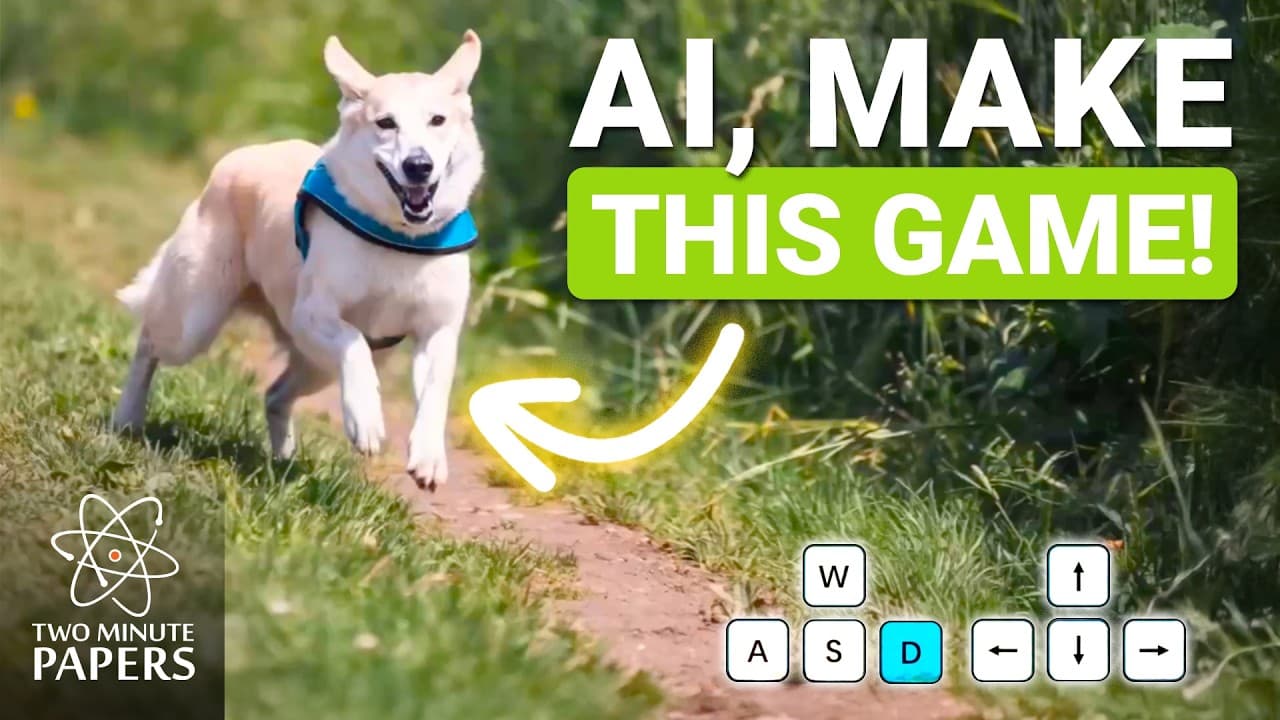
Early AI systems could generate 2D platformer games from images, assisting in game creation, but were limited to this specific genre.
Prior AI methods failed to create robust 3D open-world games and exhibited significant incoherence when attempting simple actions like turning around or stepping left, leading to buggy or incorrect environmental responses even in recent research.
GameCraft, a new research work from the Tencent lab, was trained on one million gameplay recordings, enabling it to produce highly coherent and accurate interactive scenes that respond precisely to user inputs. This advancement signifies a remarkable leap, akin to a decade of progress achieved in merely two months.
Unlike previous techniques that struggled with complex inputs, GameCraft effectively handles multi-action situations, including simultaneous button presses and sequences of movements, working reliably across various scenarios.
GameCraft also supports third-person views, a more challenging task than first-person perspectives, as it necessitates computing the dynamics and movement of complex objects like cars, ships, or horses within the generated environment.
The AI demonstrates exceptional faithfulness by seamlessly completing and synthesizing the rest of the world from diverse input images, making the transition between the input and the imagined content undetectable.
An unexpected application of GameCraft is its ability to bring favorite pets or even humans to life in virtual or realistic-looking worlds, potentially allowing users to revisit cherished memories as interactive, living environments instead of static photos.
The distilled version of GameCraft runs 20 times faster than previous methods, achieving 6.6 frames per second, largely due to a key innovation that merges keyboard and mouse motion into a continuous camera representation.
While users can navigate scenes with controls, the current iteration of GameCraft lacks interaction with characters, which is considered crucial for truly immersive gameplay.
Given the rapid advancements observed in just a few months, the potential capabilities of future AI systems in interactive world generation are expected to be even more significant.
GameCraft from the Tencent lab demonstrates coherence and accuracy, representing a decade of progress in just two months.
| insight | details |
|---|---|
| Previous AI Limitations | Earlier AI systems for game creation were limited to 2D platformers and often produced incoherent, glitchy 3D responses to user input. |
| GameCraft's Breakthrough | Tencent's GameCraft, trained on one million gameplay recordings, achieves highly coherent, accurate, and seamless 3D interactive world generation. |
| Advanced Capabilities | GameCraft supports multi-action commands, third-person views (handling complex object dynamics), and demonstrates high environmental faithfulness. |
| Performance Boost | Its distilled version runs 20 times faster (6.6 FPS) than prior methods, leveraging a continuous camera representation by merging keyboard and mouse motion. |
| Unexpected Applications | The AI enables bringing pets/humans into virtual worlds and re-experiencing memories as interactive, navigable environments. |
| Current Limitation | The current system lacks interaction with characters, which is necessary for a truly immersive 'gameplay' feel. |
| Future Outlook | Rapid progress in AI-powered world generation suggests vastly more capable systems are imminent. |