
16 Oct 2025
OpenAI has unveiled GPT-OSS, its first open-weight AI model, marking a significant historical milestone in artificial intelligence development. This model demonstrates exceptional performance across various benchmarks, including health-based queries, and is poised for widespread accessibility on personal devices.
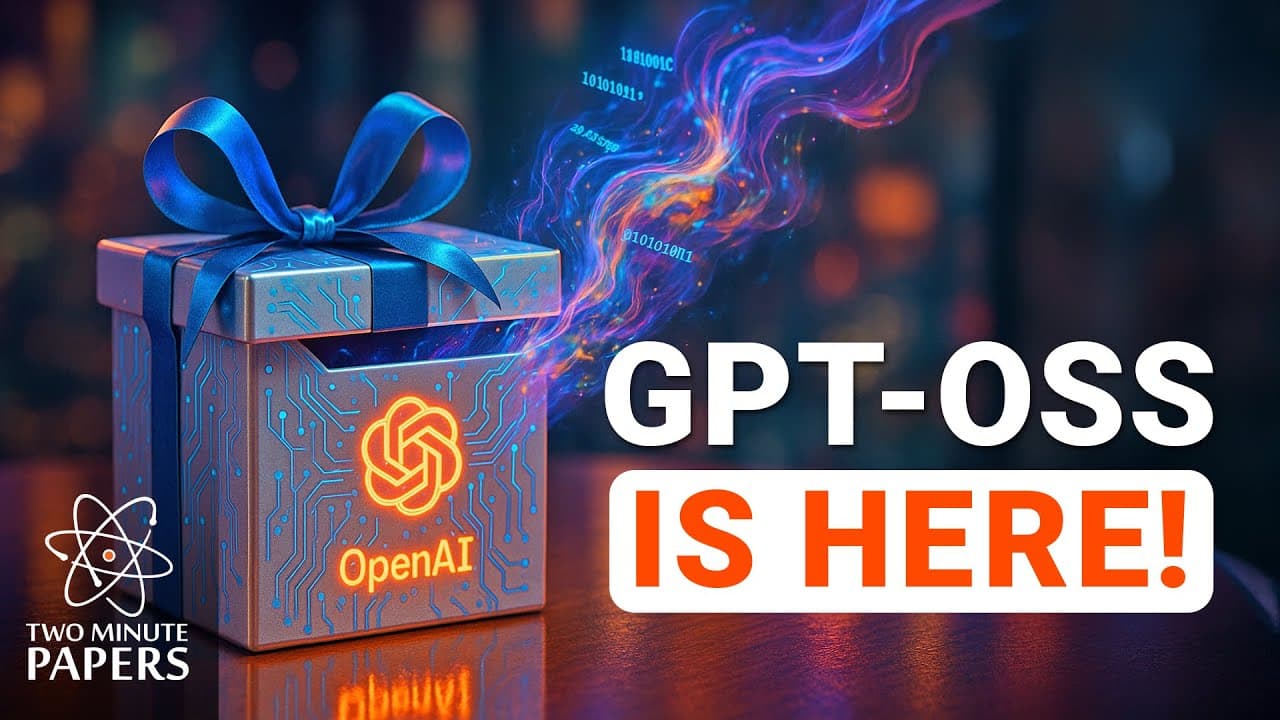
OpenAI has released GPT-OSS, its first open-weight AI model, which is considered a historic development, likened to discovering a fully functional space shuttle in an unexpected place.
GPT-OSS is available in two versions: one for high-end laptops and a medium-sized version compatible with lower-end computers, with expectations that it will soon run on mobile phones.
GPT-OSS successfully answered 19 out of 100 questions on 'Humanity’s Last Exam,' a highly challenging test for advanced AIs, significantly surpassing the closed GPT-4o model, which scored less than 3.
The model performs unexpectedly well on health-based questions, rivaling leading proprietary solutions like o3, offering potential as an offline, portable personal doctor during emergencies without connectivity.
GPT-OSS tends to generate fabricated information in the majority of its answers when tested with niche questions, indicating a limitation in its knowledge base for highly specific domains.
GPT-OSS is simple to run and available for free; however, it only supports text input and lacks multimodal capabilities, meaning it cannot process images.
The estimated training cost for the larger GPT-OSS model is less than 10 million dollars, and for the smaller version, potentially less than one million dollars, which is considerably lower than initial estimations.
The surprisingly low training costs foreshadow a rapid increase in free AI models with similar capabilities, fostering intense competition and leading to a vast ecosystem of equivalent or superior open models in the near future.
GPT-OSS is highly customizable, allowing for fine-tuning for specific applications such as legal contract analysis, biotech literature mining, and academic peer-review assistance.
The low estimated training cost suggests a future where many more free AI models with similar capabilities emerge, leading to huge competition and a vast ecosystem of equivalent or superior open models.
| Aspect | Detail |
|---|---|
| Model Name | GPT-OSS |
| Model Type | Open-weight AI model |
| Availability | Two versions: high-end laptop and medium-sized for lower-end computers |
| Humanity's Last Exam Score | 19 out of 100 questions answered correctly |
| Health Questions Performance | Unexpectedly strong, rivals best proprietary solutions (e.g., o3) |
| Hallucination Tendency | Makes up information in majority of answers for niche topics |
| Multimodal Support | None (Text-only processing) |
| Estimated Training Cost (Bigger Model) | Less than $10 million |
| Estimated Training Cost (Smaller Model) | Less than $1 million |
| Future Impact of Low Cost | Anticipated surge in free AI models, intense competition, and a rich open model ecosystem |
| Customizability | Fine-tunable for specific applications (e.g., legal, biotech, academic assistance) |