
16 Oct 2025
A groundbreaking new research paper introduces an advanced fluid simulation technique, significantly improving upon previous methods like Wavelet Turbulence and FLIP. This innovative method integrates adaptive particles and grids, enabling highly efficient and high-quality simulations of complex fluid phenomena, including water spray and large-scale impacts.
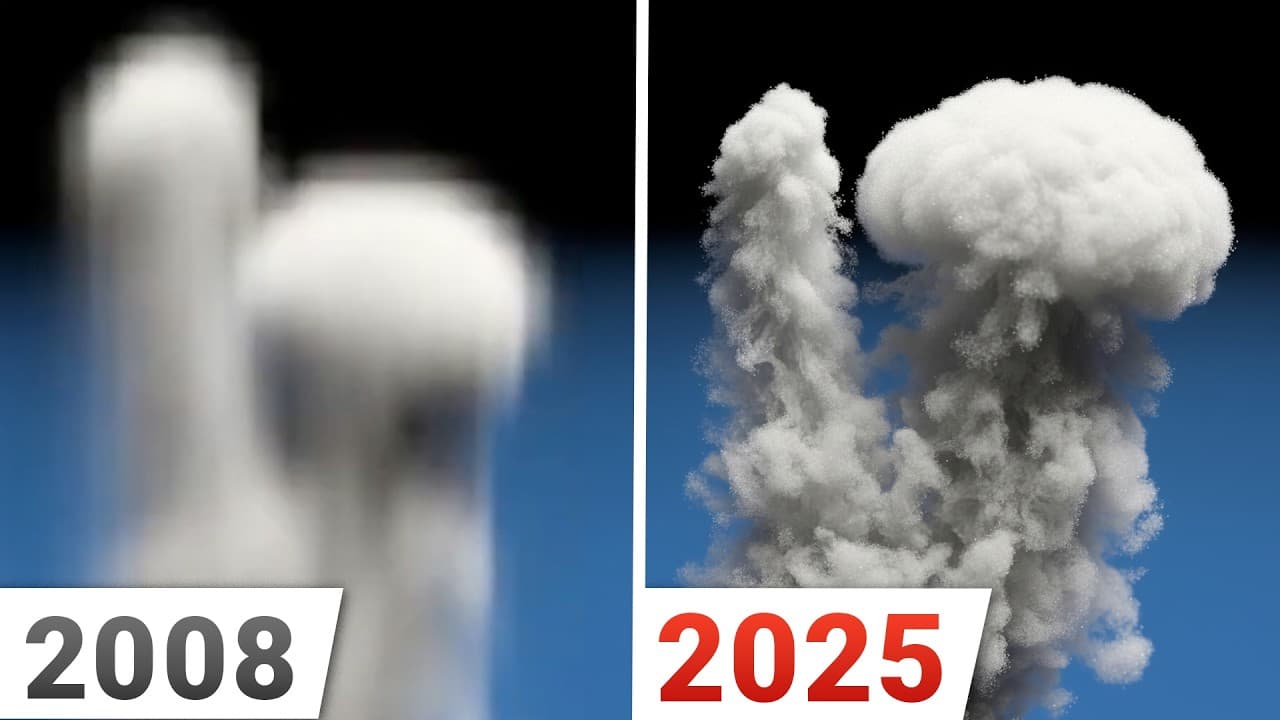
Wavelet Turbulence is a highly acclaimed paper, even winning a technical Oscar award, for its ability to transform quickly computed low-resolution simulations into breathtaking high-quality visuals. It is considered one of the best papers ever written in the field.
Techniques like Wavelet Turbulence, which rely on fixed boxes of cells (grids), suffer from inefficiency when simulating large scenes. Expanding the grid to cover vast areas drastically increases memory and computational costs, making them impractical.
Particle-based techniques offer a solution to grid confinement by allowing particles to travel freely, addressing the limitation of fixed boxes. These methods are not bound to a grid structure.
Despite their freedom, particle-based simulations become inefficient at large scales because each particle must repeatedly search for neighboring particles within a certain radius to compute properties like pressure and density at every time step. This process is computationally intensive for billions of particles.
Computer graphics researchers developed hybrid methods like FLIP (Fluid Implicit Particle) to overcome the inefficiencies of pure particle-based systems. FLIP combines particles and grids, where particles send information to a central grid for collective calculations, and the grid then transfers results back to the particles, efficiently managing large numbers of interactions.
FLIP faces challenges in easily combining air and water interactions, making accurate spray particles difficult to achieve. Furthermore, cinematic simulations requiring billions of particles and huge grids remain too costly even with FLIP's hybrid approach.
A new research paper introduces an advanced technique that achieves high-quality fluid simulations, including realistic water spray particles, with unprecedented speed and efficiency. This method addresses the previous limitations of FLIP and other techniques, enabling complex simulations that were previously impossible.
This new technique uniquely combines adaptive particles and adaptive grids, which is a significant advancement. It allocates computational power only where activity occurs, like concentrating particles in areas of fluid action and adjusting grid resolution dynamically, leading to highly efficient resource use.
The technique utilizes a phase field to naturally separate air and water interactions, eliminating the need for manual tracing of shorelines or interfaces. This automatically defines the boundary between fluid and air, enhancing realism and simplifying the simulation process.
A fast adaptive Poisson solver is integrated into the technique to prevent pressure computations from consuming excessive runtime. This ensures that even with complex calculations, the overall simulation speed remains high by efficiently processing pressure dynamics.
The new technique delivers remarkable performance, allowing billion-particle cinematic-resolution simulations to complete on a single workstation in minutes per frame. Its results are incredibly realistic, making them nearly indistinguishable from real photos and enabling complex scenarios like asteroid impacts or dam breaks.
Despite its advancements, the technique primarily targets offline simulation rather than real-time applications. It also has a limitation in some cases by ignoring very small-scale effects, such as surface tension.
The current capabilities of this CPU-based technique suggest immense future potential, envisioning super-fast, fully simulated storms with film-quality spray particles. This work is considered potentially even more impactful than Wavelet Turbulence, demonstrating human brilliance without needing AI.
Something that was previously close to impossible is now possible, allowing billion-particle cinematic-resolution simulations to finish on a single workstation in minutes per frame.
| Technique | Core Concept | Key Strength | Primary Limitation/Innovation |
|---|---|---|---|
| Wavelet Turbulence | Transforms low-resolution simulations into high-quality visuals. | Achieves breathtaking visual quality quickly from coarse data. | Limited to a fixed simulation box; high memory/compute cost for large scenes. |
| Particle-Based Simulations | Fluid elements represented by individual particles. | Particles move freely, not confined by grids. | Inefficient for large scales due to constant neighbor searching for calculations. |
| FLIP (Fluid Implicit Particle) | Hybrid method combining particles and grids. | Uses a grid for efficient collective calculations, particles for movement. | Difficulty combining air/water interaction; still costly for cinematic scales with billions of particles. |
| New Research Technique | Adaptive particles, adaptive grids, phase field, fast Poisson solver. | High-quality, efficient simulations with spray particles; billion-particle simulations in minutes per frame. | First to combine adaptive particles and adaptive grids; natural air/water separation; fast pressure computation; targets offline simulation, ignores tiny-scale effects. |